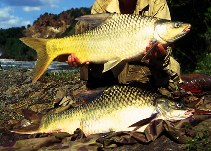
Environment: milieu / climate zone / depth range / distribution range
Ecology
Freshwater; benthopelagic. Subtropical; 32°N - 3°N
Africa: Nile River and lakes once connected to the Nile system (Ref. 2801, 2959); Chad, Niger, Senegal, Volta, Ouémé and Ogun river basins (Ref. 2940, 81282); coastal rivers (Sassandra, Bandama, Niouniourou, Comoé and Tano) of Côte d'Ivoire and Ghana, west of the Volta basin. Following subspecies are recognized: Labeobarbus bynni bynni; Labeobarbus bynni occidentalis and Labeobarbus bynni waldroni.
Size / Weight / Age
Maturity: Lm ? range ? - ? cm
Max length : 82.0 cm TL male/unsexed; (Ref. 2801)
Anal
soft rays: 8. Diagnosis: last simple dorsal-fin ray forming ossified spine longer than head in specimens over 150 mm SL; scale formula 5.5/26-31/4.5-5.5; 2.5-3 scales between lateral line and middle of belly, behind pelvic-fin origin; 12 scales around caudal peduncle; dorsal fin with 4 unbrached and 9 branched rays; anal fin with 3 unbranched and 5 branched rays; pectoral fin with 16-19 rays; pelvic fin with 1 unbranched and 8 branched rays; 3-5/12-15 gill rakers on first gill arch (Ref. 2940, 81282).
Feed on crustaceans, insects, molluscs and organic debris; in the Jebel Aulia Reservoir, annual spawning coincides with the onset of the floods; fecundity estimates ranged from 72 x 1,000 at 33 cm (4 yrs.) to over 14 x 10,000 at 74 cm (8 yrs) (Ref. 28714).
Life cycle and mating behavior
Maturity | Reproduction | Spawning | Eggs | Fecundity | Larvae
Lévêque, C. and J. Daget, 1984. Cyprinidae. p. 217-342. In J. Daget, J.-P. Gosse and D.F.E. Thys van den Audenaerde (eds.) Check-list of the freshwater fishes of Africa (CLOFFA). ORSTOM, Paris and MRAC, Tervuren. Vol. 1. (Ref. 2801)
IUCN Red List Status (Ref. 130435)
Threat to humans
Harmless
Human uses
Gamefish: yes
More information
Common namesSynonymsMetabolismPredatorsEcotoxicologyReproductionMaturitySpawningSpawning aggregationFecundityEggsEgg development
ReferencesAquacultureAquaculture profileStrainsGeneticsElectrophoresesHeritabilityDiseasesProcessingNutrientsMass conversion
Tools
Special reports
Download XML
Internet sources
Estimates based on models
Phylogenetic diversity index (Ref.
82804): PD
50 = 0.5000 [Uniqueness, from 0.5 = low to 2.0 = high].
Bayesian length-weight: a=0.00933 (0.00422 - 0.02065), b=3.01 (2.82 - 3.20), in cm total length, based on LWR estimates for this (Sub)family-body shape (Ref.
93245).
Trophic level (Ref.
69278): 3.1 ±0.40 se; based on food items.
Generation time: 4.2 ( na - na) years. Estimated as median ln(3)/K based on 1
growth studies.
Resilience (Ref.
120179): Medium, minimum population doubling time 1.4 - 4.4 years (K=0.26).
Fishing Vulnerability (Ref.
59153): Moderate vulnerability (39 of 100).