Teleostei (teleosts) >
Argentiniformes (Marine smelts) >
Bathylagidae (Deep-sea smelts)
Etymology: Bathylagus: Greek, bathys = deep + Greek, lagos = hare (Ref. 45335); pacificus: Named after the Pacific Ocean (Ref. 6885).
More on author: Gilbert.
Environment: milieu / climate zone / depth range / distribution range
Ecology
Marine; bathypelagic; depth range 600 - 7700 m (Ref. 50610), usually 600 - 800 m (Ref. 28981). Deep-water; 61°N - 27°N, 140°E - 114°W
Pacific: off the Pacific coast of northern Japan and the Bering Sea to the Gulf of Alaska southward to northern Baja California, Mexico.
Size / Weight / Age
Maturity: Lm ? range ? - ? cm
Max length : 25.0 cm SL male/unsexed; (Ref. 4525)
Dorsal
spines
(total): 0;
Dorsal
soft rays
(total): 8-13;
Anal
spines: 0;
Anal
soft rays: 15 - 25;
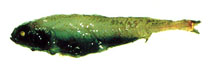
Vertebrae: 44 - 51. Body slender and compressed. Anal fin base long and about twice the length of dorsal fin base. Eye diameter about twice snout length. Upper end of gill slit reaching above midline of side of body. No knob-like process in interorbital space. Dorsoposterior edge of operculum not curved inward. Traces of detached scales black. Color black or dark brown; bluish black on head and ventral surfaces, and on peritoneum (Ref. 6885).
Does not undertake a diurnal, vertical migration. Feeds heavily on crustaceans (Ref. 4525). Oviparous, with planktonic eggs and larvae (Ref. 35604). Minimum cdepth from Ref. 028981.
Masuda, H., K. Amaoka, C. Araga, T. Uyeno and T. Yoshino, 1984. The fishes of the Japanese Archipelago. Vol. 1. Tokai University Press, Tokyo, Japan. 437 p. (text). (Ref. 559)
IUCN Red List Status (Ref. 130435)
Threat to humans
Harmless
Human uses
Tools
Special reports
Download XML
Internet sources
Estimates based on models
Preferred temperature (Ref.
123201): 0.4 - 5.2, mean 3.2 °C (based on 91 cells).
Phylogenetic diversity index (Ref.
82804): PD
50 = 0.5078 [Uniqueness, from 0.5 = low to 2.0 = high].
Bayesian length-weight: a=0.00776 (0.00458 - 0.01316), b=3.07 (2.92 - 3.22), in cm total length, based on LWR estimates for this species & (Sub)family-body (Ref.
93245).
Trophic level (Ref.
69278): 3.3 ±0.42 se; based on food items.
Generation time: 7.8 ( na - na) years. Estimated as median ln(3)/K based on 1
growth studies.
Resilience (Ref.
120179): Low, minimum population doubling time 4.5 - 14 years (K=0.14 (very tentative estimate)).
Fishing Vulnerability (Ref.
59153): Moderate to high vulnerability (52 of 100).
Nutrients (Ref.
124155): Calcium = 29.9 [10.3, 96.3] mg/100g; Iron = 0.365 [0.142, 1.282] mg/100g; Protein = 13.7 [10.4, 17.9] %; Omega3 = 0.395 [0.118, 1.350] g/100g; Selenium = 21 [7, 55] μg/100g; VitaminA = 38 [5, 303] μg/100g; Zinc = 0.672 [0.358, 1.397] mg/100g (wet weight);