Teleostei (teleosts) >
Tetraodontiformes (Puffers and filefishes) >
Tetraodontidae (Puffers) > Tetraodontinae
Etymology: Sphoeroides: Greek, sphaira = ball + Greek, suffix, oides = similar to (Ref. 45335).
More on author: Bloch.
Environment: milieu / climate zone / depth range / distribution range
Ecology
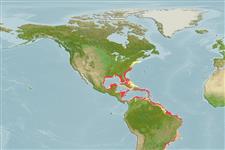
Marine; brackish; reef-associated; depth range 2 - 70 m (Ref. 26999). Subtropical; 43°N - 30°S, 98°W - 34°W
Western Atlantic: Massachusetts, USA to Santa Catarina, Brazil (Ref. 57756). Replaced by Sphoeroides marmoratus in the eastern Atlantic (P. Wirtz, pers. comm. 10/04).
Size / Weight / Age
Maturity: Lm ? range ? - ? cm
Max length : 30.0 cm TL male/unsexed; (Ref. 26999); common length : 12.0 cm TL male/unsexed; (Ref. 3821)
Dorsal
soft rays
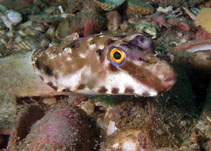
(total): 9. 11-14 sharply defined round black spots on head and lower side of body. The numerous tan lappers on the rear part of the body and distinct spots along the lower side make it unmistakable (Ref. 26938).
Abundant in all inshore habitats where there is adequate cover, such as seagrass beds and reef flats. Feeds on mollusks, crustaceans and echinoderms (Ref. 36453). Generally common (Ref. 9710). Traded as an aquarium fish at Ceará, Brazil (Ref. 49392).
Life cycle and mating behavior
Maturity | Reproduction | Spawning | Eggs | Fecundity | Larvae
Robins, C.R. and G.C. Ray, 1986. A field guide to Atlantic coast fishes of North America. Houghton Mifflin Company, Boston, U.S.A. 354 p. (Ref. 7251)
IUCN Red List Status (Ref. 130435)
Threat to humans
Poisonous to eat (Ref. 3821)
Human uses
Fisheries: of no interest; aquarium: commercial
More information
ReferencesAquacultureAquaculture profileStrainsGeneticsElectrophoresesHeritabilityDiseasesProcessingNutrientsMass conversion
Tools
Special reports
Download XML
Internet sources
Estimates based on models
Preferred temperature (Ref.
123201): 22.5 - 28, mean 25 °C (based on 472 cells).
Phylogenetic diversity index (Ref.
82804): PD
50 = 0.5000 [Uniqueness, from 0.5 = low to 2.0 = high].
Bayesian length-weight: a=0.01738 (0.01350 - 0.02236), b=2.90 (2.83 - 2.97), in cm total length, based on LWR estimates for this species (Ref.
93245).
Trophic level (Ref.
69278): 3.3 ±0.2 se; based on diet studies.
Resilience (Ref.
120179): High, minimum population doubling time less than 15 months (Preliminary K or Fecundity.).
Fishing Vulnerability (Ref.
59153): Low vulnerability (20 of 100).
Nutrients (Ref.
124155): Calcium = 32.6 [10.8, 107.5] mg/100g; Iron = 0.68 [0.34, 1.43] mg/100g; Protein = 19.7 [17.5, 21.9] %; Omega3 = 0.262 [0.123, 0.509] g/100g; Selenium = 15.9 [7.1, 34.3] μg/100g; VitaminA = 42.4 [13.0, 139.6] μg/100g; Zinc = 0.993 [0.654, 1.519] mg/100g (wet weight);