Teleostei (teleosts) >
Acanthuriformes (Surgeonfishes) >
Ephippidae (Spadefishes, batfishes and scats)
Etymology: Chaetodipterus: Greek, chaite = hair + Greek, dipteros = with two fins (Ref. 45335).
Environment: milieu / climate zone / depth range / distribution range
Ecology
Marine; brackish; reef-associated; oceanodromous (Ref. 51243); depth range 3 - 35 m (Ref. 26912). Subtropical; 43°N - 34°S, 98°W - 34°W
Western Atlantic: Massachusetts, USA and northern Gulf of Mexico to Rio Grande do Sul, Brazil (Ref. 47377).
Length at first maturity / Size / Weight / Age
Maturity: Lm ?, range 12 - ? cm
Max length : 91.0 cm TL male/unsexed; (Ref. 7251); common length : 50.4 cm TL male/unsexed; (Ref. 26466); max. published weight: 9.0 kg (Ref. 7251)
Dorsal
spines
(total): 9;
Dorsal
soft rays
(total): 21-24;
Anal
spines: 3;
Anal
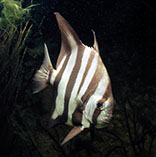
soft rays: 17 - 18. Very deep-bodied, compressed, disk-shaped fish with a very blunt snout. Irregular, bold, blackish, vertical bands that fade with age. Second dorsal and anal fins have high anterior lobes (Ref. 26938). Mouth small, the maxilla of adults ending beneath nostrils; no teeth on roof of mouth; scales ctenoid; head and fins scaled; opercle ends in an obtuse point (Ref. 13442).
Abundant in shallow coastal waters, from mangroves and sandy beaches to wrecks and harbors. Juveniles (black phase) are common in estuaries and often found in very shallow water swimming at an angle resembling dead leaves or as infertile red mangrove pods and other debris. Adults often occur in very large schools of up to 500 individuals (Ref. 9710). Feed on benthic invertebrates like crustaceans, mollusks, annelids, cnidarians as well as on plankton (Ref. 35237). Good food fish (Ref. 5521); marketed fresh (Ref. 5217). Often circles divers (Ref. 9710). Minimum depth from Ref. 9710. In southeastern Brazil found between 23 and 45 m (Ref. 47377). Has been reared in captivity (Ref. 35425).
Life cycle and mating behavior
Maturity | Reproduction | Spawning | Eggs | Fecundity | Larvae
Robins, C.R. and G.C. Ray, 1986. A field guide to Atlantic coast fishes of North America. Houghton Mifflin Company, Boston, U.S.A. 354 p. (Ref. 7251)
IUCN Red List Status (Ref. 130435)
Threat to humans
Reports of ciguatera poisoning (Ref. 30303)
Human uses
Fisheries: minor commercial; aquaculture: commercial; gamefish: yes; aquarium: public aquariums
More information
ReferencesAquacultureAquaculture profileStrainsGeneticsElectrophoresesHeritabilityDiseasesProcessingNutrientsMass conversion
Tools
Special reports
Download XML
Internet sources
Estimates based on models
Preferred temperature (Ref.
123201): 22.6 - 28, mean 25.4 °C (based on 380 cells).
Phylogenetic diversity index (Ref.
82804): PD
50 = 0.6250 [Uniqueness, from 0.5 = low to 2.0 = high].
Bayesian length-weight: a=0.03311 (0.02580 - 0.04250), b=2.94 (2.87 - 3.01), in cm total length, based on LWR estimates for this species (Ref.
93245).
Trophic level (Ref.
69278): 4.5 ±0.0 se; based on diet studies.
Resilience (Ref.
120179): Medium, minimum population doubling time 1.4 - 4.4 years (tmax=8; tm=1; K=0.34).
Fishing Vulnerability (Ref.
59153): Moderate to high vulnerability (49 of 100).
Nutrients (Ref.
124155): Calcium = 16 [7, 41] mg/100g; Iron = 0.412 [0.214, 0.762] mg/100g; Protein = 20.3 [19.1, 21.4] %; Omega3 = 0.165 [0.090, 0.311] g/100g; Selenium = 15.9 [6.9, 34.9] μg/100g; VitaminA = 24.7 [5.6, 116.7] μg/100g; Zinc = 0.532 [0.327, 0.832] mg/100g (wet weight);