Classification / Names
Common names | Synonyms | Catalog of Fishes(genus, species) | ITIS | CoL | WoRMS | Cloffa
Teleostei (teleosts) >
Characiformes (Characins) >
Bryconidae ("Brycon characins") > Salmininae
Etymology: Salminus: I think it could be derived from Latin, salmo, -onis = salmon; diminutive; franciscanus: Named for the river basin São Francisco, from which the species is endemic..
Environment: milieu / climate zone / depth range / distribution range
Ecology
Freshwater; pelagic-neritic. Tropical
South America: Brazil.
Size / Weight / Age
Maturity: Lm ? range ? - ? cm
Max length : 75.5 cm SL male/unsexed; (Ref. 75797)
Short description
Morphology | Morphometrics
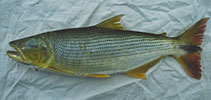
This species is distinguished from all its congeners, except S. brasiliensis, by the following characters: presence of a second dentary tooth in the outer tooth series that is considerably larger than the remaining teeth (vs. second dentary teeth only slightly larger than remaining teeth in S. affinis and S. hilarii); it differs from S. affinis by the absence of the dark post-orbital stripe (vs. present); differs from S. brasiliensis in having 68-82 (modally 77) lateral line scales (vs. 79-102, modally 96), 11-14 (modally 12) horizontal scales between dorsal-fin origin and lateral line (vs. 14-18, modally 16), and 6-8(modally 6) horizontal scales between lateral line and pelvic-fin insertion (vs. 6-9, modally 8). In spite of the great overlap, compared to the sympatric S. hilarii, this species has generally more scales on the lateral line (vs. 54-72, modally 65-66), horizontal between dorsal-fin origin and lateral line (vs. 9-12, modally 10), and horizontal between lateral line and pelvic-fin insertion (vs. 4-7, modally 5); it also differs by having a golden coloration mainly over the facial bones and pectoral girdle (vs. facial bones and pectoral girdle silvery) (Ref. 75797).
There is little published information about the general biology and ecology of this species when compared to its much better known S. brasiliensis, even though this species has been recognized as distinct (even if under misapplied names) since late 19th century. Under the name S. brasiliensis, it has been reported to reach one meter in total length and weigh up to 30 kg, consequently, one of the largest known Characiformes; piscivorous; undertakes reproductive migrations during the rainy season; juveniles (< 600 g) were collected in marginal lagoons of the rio São Francisco, an indication that these are recruiting habitats for the species; one of the main targets of the commercial and amateur fisheries in the middle rio São Francisco basin (Ref. 75797).
Life cycle and mating behavior
Maturity | Reproduction | Spawning | Eggs | Fecundity | Larvae
Lima, F.C.T. and H.A. Britski, 2007. Salminus franciscanus, a new species from the rio São Francisco basin, Brazil (Ostariophysi: Characiformes: Characidae). Neotrop. Ichthyol. 5(3):237-244. (Ref. 75797)
IUCN Red List Status (Ref. 130435)
Threat to humans
Harmless
Human uses
More information
Common namesSynonymsMetabolismPredatorsEcotoxicologyReproductionMaturitySpawningSpawning aggregationFecundityEggsEgg development
Age/SizeGrowthLength-weightLength-lengthLength-frequenciesMorphometricsMorphologyLarvaeLarval dynamicsRecruitmentAbundanceBRUVS
ReferencesAquacultureAquaculture profileStrainsGeneticsElectrophoresesHeritabilityDiseasesProcessingNutrientsMass conversion
Tools
Special reports
Download XML
Internet sources
Estimates based on models
Phylogenetic diversity index (Ref.
82804): PD
50 = 0.5625 [Uniqueness, from 0.5 = low to 2.0 = high].
Bayesian length-weight: a=0.01000 (0.00424 - 0.02357), b=3.08 (2.88 - 3.28), in cm total length, based on LWR estimates for this (Sub)family-body shape (Ref.
93245).
Trophic level (Ref.
69278): 2.7 ±0.2 se; based on size and trophs of closest relatives
Resilience (Ref.
120179): Medium, minimum population doubling time 1.4 - 4.4 years (Preliminary K or Fecundity.).
Fishing Vulnerability (Ref.
59153): High vulnerability (57 of 100).