Issue
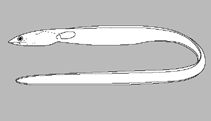
The species is known only from its larvae. Please send references or mores studies are needed.
Environment: milieu / climate zone / depth range / distribution range
Ecology
Marine; pelagic-neritic. Tropical
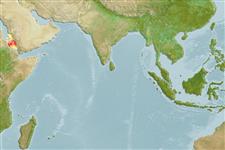
Western Indian Ocean: Red Sea.
Size / Weight / Age
Maturity: Lm ? range ? - ? cm
Life cycle and mating behavior
Maturity | Reproduction | Spawning | Eggs | Fecundity | Larvae
Goren, M. and M. Dor, 1994. An updated checklist of the fishes of the Red Sea (CLOFRES II). The Israel Academy of Sciences and Humanities, Jerusalem, Israel. 120 p. (Ref. 12541)
IUCN Red List Status (Ref. 130435)
Threat to humans
Harmless
Human uses
More information
Common namesSynonymsMetabolismPredatorsEcotoxicologyReproductionMaturitySpawningSpawning aggregationFecundityEggsEgg development
Age/Size
Growth
Length-weight
Length-length
Length-frequencies
Morphometrics
Morphology
Larvae
Larval dynamics
Recruitment
Abundance
BRUVS
ReferencesAquacultureAquaculture profileStrainsGeneticsElectrophoresesHeritabilityDiseasesProcessingNutrientsMass conversion
Tools
Special reports
Download XML
Internet sources
Estimates based on models
Preferred temperature (Ref.
123201): 23.7 - 29.4, mean 28.6 °C (based on 19 cells).
Phylogenetic diversity index (Ref.
82804): PD
50 = No PD50 data [Uniqueness, from 0.5 = low to 2.0 = high].
Bayesian length-weight: a=0.00076 (0.00029 - 0.00199), b=3.06 (2.83 - 3.29), in cm total length, based on LWR estimates for this (Sub)family-body shape (Ref.
93245).
Trophic level (Ref.
69278): 4.3 ±0.7 se; based on size and trophs of closest relatives
Resilience (Ref.
120179): Medium, minimum population doubling time 1.4 - 4.4 years (Preliminary K or Fecundity.).
Fishing Vulnerability (Ref.
59153): Moderate vulnerability (43 of 100).