Teleostei (teleosts) >
Clupeiformes (Herrings) >
Engraulidae (Anchovies) > Coiliinae
Etymology: Setipinna: Latin, septem = seven + Latin, pinna, -ae = fin.
More on author: Hamilton.
Environment: milieu / climate zone / depth range / distribution range
Ecology
Freshwater; brackish; pelagic; amphidromous (Ref. 51243). Subtropical; 30°N - 6°N, 84°E - 100°E
Asia: Indian fresh and brackish waters (Ganges system, from Diamond Harbor on the Hooghly to as far up as Allahabad on the Ganges, perhaps further; also rivers and estuaries of Orissa). Reported from Bangladesh and Myanmar (Ref. 45255).
Length at first maturity / Size / Weight / Age
Maturity: Lm 14.5 range ? - ? cm
Max length : 40.0 cm TL male/unsexed; (Ref. 189)
Dorsal
spines
(total): 0;
Anal
spines: 0;
Anal
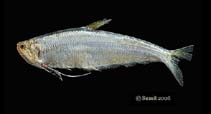
soft rays: 66 - 78. Belly with 21 or 22 keeled scutes from isthmus to anus. Lower gill rakers with the serrae even or becoming clumped in some specimens. Pectoral filament long, reaching to base of 15th to 39th anal fin ray. Anal fin with upper caudal lobe truncated, shorter than lower. Pectoral fins hyaline, but dark in fishes over 13.6 cm SL.
A riverine species, but also found in estuaries and presumably tolerating some salinity. Adults feed mainly on mysids and small prawns (reduced feeding during breeding), juveniles mainly on copepods. Possibly breeds throughout the year, with peaks in October and November (Hooghly at Barrackpore) or March-May (Ganges at Allahabad). Its large size makes it an attractive foodfish.
Life cycle and mating behavior
Maturity | Reproduction | Spawning | Eggs | Fecundity | Larvae
Has an extended breeding season, possibly throughout the year.
Whitehead, P.J.P., G.J. Nelson and T. Wongratana, 1988. FAO Species Catalogue. Vol. 7. Clupeoid fishes of the world (Suborder Clupeoidei). An annotated and illustrated catalogue of the herrings, sardines, pilchards, sprats, shads, anchovies and wolf-herrings. FAO Fish. Synop. 125(7/2):305-579. Rome: FAO. (Ref. 189)
IUCN Red List Status (Ref. 130435)
Threat to humans
Harmless
Human uses
Fisheries: minor commercial
Tools
Special reports
Download XML
Internet sources
Estimates based on models
Phylogenetic diversity index (Ref.
82804): PD
50 = 0.5039 [Uniqueness, from 0.5 = low to 2.0 = high].
Bayesian length-weight: a=0.00417 (0.00253 - 0.00688), b=3.09 (2.95 - 3.23), in cm total length, based on LWR estimates for this species & (Sub)family-body (Ref.
93245).
Trophic level (Ref.
69278): 3.3 ±0.39 se; based on food items.
Generation time: 4.5 ( na - na) years. Estimated as median ln(3)/K based on 1
growth studies.
Resilience (Ref.
120179): Medium, minimum population doubling time 1.4 - 4.4 years (K=0.24).
Fishing Vulnerability (Ref.
59153): Moderate vulnerability (39 of 100).
Nutrients (Ref.
124155): Calcium = 103 [33, 282] mg/100g; Iron = 1.55 [0.73, 3.12] mg/100g; Protein = 20.5 [18.6, 22.3] %; Omega3 = 0.666 [0.379, 1.333] g/100g; Selenium = 18.4 [9.3, 36.9] μg/100g; VitaminA = 3.3 [0.9, 13.5] μg/100g; Zinc = 1.02 [0.47, 2.86] mg/100g (wet weight); based on
nutrient studies.