Teleostei (teleosts) >
Centrarchiformes (Basses) >
Kuhliidae (Aholeholes)
Etymology: Kuhlia: Because of Heindrich Kuhl, 1797-1821; researcher also with lizards (Gekkonidae).
More on author: Cuvier.
Environment: milieu / climate zone / depth range / distribution range
Ecology
Freshwater; brackish; demersal; catadromous (Ref. 51243); depth range ? - 2 m (Ref. 86942). Tropical; 32°N - 28°S
Asia and Oceania: Taiwan, Philippines and Indonesia to islands in the Pacific. The name Kuhlia marginata has been misapplied to other species and therefore some literature records may be suspect (Ref. 41640).
Size / Weight / Age
Maturity: Lm ? range ? - ? cm
Max length : 17.9 cm SL male/unsexed; (Ref. 41640)
Dorsal
spines
(total): 10;
Dorsal
soft rays
(total): 10-12;
Anal
spines: 3;
Anal
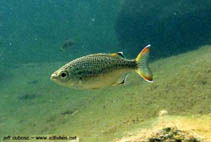
soft rays: 11 - 12. Preorbital serrae 18-28; a few fine serrae may be present on suborbital; body depth 2.7-3.05 in SL; orbit diameter 2.75-3.3 in head length; maxilla extending to or slightly beyond a vertical at front edge of pupil; caudal concavity 2.5-3.1 in head length. Silvery, usually with blackish spots posteriorly on dorsal part of body that tends to merge to form bands anteriorly (or the dark pigment is concentrated on scale margins); most of snout and tip of chin blackish; caudal fin pale with a black posterior margin that broadens on lobe tips, then a very broad submarginal pale zone, often preceded by a chevron-shaped blackish band or row of blackish spots parallel with posterior margin; base of caudal fin with small blackish spots; a narrow white margin on soft portion of dorsal and anal fins with a broad blackish submarginal zone anteriorly that narrows posteriorly (broader in dorsal fin than anal) (Ref. 41640).
Primarily a freshwater species; extent of penetration into brackish and marine environments uncertain (Ref. 41640). Has been found in moderately deep (1.5-3 m), rocky, unshaded, flowing water areas of mid-hill rivers (Ref. 6028).
Life cycle and mating behavior
Maturity | Reproduction | Spawning | Eggs | Fecundity | Larvae
Randall, J.E. and H.A. Randall, 2001. Review of the fishes of the genus Kuhlia (Perciformes: Kuhliidae) of the Central Pacific. Pac. Sci. 55(3):227-256. (Ref. 41640)
IUCN Red List Status (Ref. 130435)
Threat to humans
Harmless
Human uses
Fisheries: commercial; aquarium: public aquariums
More information
Common namesSynonymsMetabolismPredatorsEcotoxicologyReproductionMaturitySpawningSpawning aggregationFecundityEggsEgg development
ReferencesAquacultureAquaculture profileStrainsGeneticsElectrophoresesHeritabilityDiseasesProcessingNutrientsMass conversion
Tools
Special reports
Download XML
Internet sources
Estimates based on models
Phylogenetic diversity index (Ref.
82804): PD
50 = 0.5002 [Uniqueness, from 0.5 = low to 2.0 = high].
Bayesian length-weight: a=0.01230 (0.00690 - 0.02192), b=3.06 (2.90 - 3.22), in cm total length, based on LWR estimates for this species & (Sub)family-body (Ref.
93245).
Trophic level (Ref.
69278): 3.4 ±0.5 se; based on size and trophs of closest relatives
Resilience (Ref.
120179): Medium, minimum population doubling time 1.4 - 4.4 years (Preliminary K or Fecundity.).
Fishing Vulnerability (Ref.
59153): Low vulnerability (12 of 100).