Environment: milieu / climate zone / depth range / distribution range
Ecology
Freshwater; demersal. Tropical
Asia: Mekong basin.
Size / Weight / Age
Maturity: Lm ? range ? - ? cm
Max length : 10.0 cm SL male/unsexed; (Ref. 30857)
Dorsal
soft rays
(total): 12;
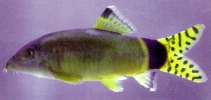
Vertebrae: 31. Differs from all other species in having a large dark mark on caudal peduncle forming a complete ring (i.e. going completely around caudal peduncle) and outlined anteriorly as well as posteriorly by complete pale rings. It differs from all species except B. morleti in having dorsal, anal, and caudal fins pale or bright yellow, with distinctive round, oval, or oblong dark spots on caudal fin. It entirely lacks the complete dorsomedian black stripe diagnostic of the species B. morleti. Spots on the caudal fin fewer but larger, and submarginal dark stripe on dorsal and anal fins better defined than in B. morleti (Ref. 31466). Dorsal fin with 8 branched rays; 14-19 narrow irregular bars on side (Ref. 43281).
Inhabits swift or moderately swift, clearwater, foothill streams with predominantly rocky or cobblestone bottom (Ref. 31466). Collected together with B. sidthimunki/i> and Botia (Hymenophysa sp. (Ref. 31466).
Life cycle and mating behavior
Maturity | Reproduction | Spawning | Eggs | Fecundity | Larvae
Kottelat, M., 2004. Botia kubotai, a new species of loach (Teleostei: Cobitidae) from the Ataran River basin (Myanmar), with comments on botiine nomenclature and diagnosis of a new genus. Zootaxa 401:1-18. (Ref. 50472)
IUCN Red List Status (Ref. 130435)
Threat to humans
Harmless
Human uses
More information
Common namesSynonymsMetabolismPredatorsEcotoxicologyReproductionMaturitySpawningSpawning aggregationFecundityEggsEgg development
ReferencesAquacultureAquaculture profileStrainsGeneticsElectrophoresesHeritabilityDiseasesProcessingNutrientsMass conversion
Tools
Special reports
Download XML
Internet sources
Estimates based on models
Phylogenetic diversity index (Ref.
82804): PD
50 = 0.5078 [Uniqueness, from 0.5 = low to 2.0 = high].
Bayesian length-weight: a=0.00977 (0.00420 - 0.02273), b=2.99 (2.79 - 3.19), in cm total length, based on LWR estimates for this (Sub)family-body shape (Ref.
93245).
Trophic level (Ref.
69278): 3.5 ±0.4 se; based on size and trophs of closest relatives
Fishing Vulnerability (Ref.
59153): Low vulnerability (10 of 100).