Teleostei (teleosts) >
Atheriniformes (Silversides) >
Atherinopsidae (Neotropical silversides) > Atherinopsinae
Etymology: Odontesthes: Greek, odous = teeth + Greek,esthes = suit, something used to wrap (Ref. 45335).
More on author: Valenciennes.
Environment: milieu / climate zone / depth range / distribution range
Ecology
Marine; freshwater; brackish; pelagic-neritic; depth range 1 - ? m (Ref. 27363). Subtropical; 11°C - 24°C (Ref. 52052); 26°S - 41°S
South America: southern Argentina and Río de La Plata. Introduced into Europe and Asia.
Length at first maturity / Size / Weight / Age
Maturity: Lm 13.2 range ? - ? cm
Max length : 50.0 cm TL male/unsexed; (Ref. 12187); max. reported age: 4 years (Ref. 59043)
Dorsal
spines
(total): 6;
Dorsal
soft rays
(total): 9;
Anal
spines: 1;
Anal
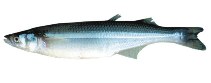
soft rays: 18 - 22. Body bluish brown dorsally, silvery ventrally. A broad silvery band with dark blue upper margin running from pectoral fin base to caudal fin base along midbody. Upper surface of head, pectoral and caudal fins blackish (Ref. 27363). Scales in the lateral line series above the lateral band 52-60; predorsal scales 28-35 (Ref. 47314).
Inhabit coastal lagoons and near estuaries, usually in freshwater (Ref. 27363, 59043). Gregarious. Adults feed on zooplankton. Mature adults spawn for the first time at 1-2 years. Eggs are deposited among aquatic vegetation (Ref. 59043). Maximum length estimated from the fact that the congeneric Odontesthes incisa has a common length of 10 cm TL. This species is a cool water predator that has affected the abundance of other species native to the lakes (Ref. 1739). The fisheries has now flourished especially in lakes and reservoirs, in Peru, Argentina, southern Brazil and Chile.
Dyer, B.S., 1998. Phylogenetic systematics and historical biogeography of the neotropical silverside family Atherinopsidae (Teleostei: Atheriniformes). p. 519-536. In L.R. Malabarba, R.E. Reis, R.P. Vari, Z.M.S. Lucena and C.A.S. Lucena (eds.) Phylogeny and classification of neotropical fishes. Porto Alegre: EDIPUCRS. (Ref. 33128)
IUCN Red List Status (Ref. 130435)
Threat to humans
Potential pest
Human uses
Fisheries: minor commercial; aquaculture: commercial; gamefish: yes
More information
ReferencesAquacultureAquaculture profileStrainsGeneticsElectrophoresesHeritabilityDiseasesProcessingNutrientsMass conversion
Tools
Special reports
Download XML
Internet sources
Estimates based on models
Phylogenetic diversity index (Ref.
82804): PD
50 = 0.5000 [Uniqueness, from 0.5 = low to 2.0 = high].
Bayesian length-weight: a=0.00741 (0.00403 - 0.01363), b=3.01 (2.84 - 3.18), in cm total length, based on LWR estimates for this species & (Sub)family-body (Ref.
93245).
Trophic level (Ref.
69278): 2.6 ±0.24 se; based on food items.
Generation time: 2.0 (1.5 - 2.8) years. Estimated as median ln(3)/K based on 32
growth studies.
Resilience (Ref.
120179): Medium, minimum population doubling time 1.4 - 4.4 years (K=0.1; tmax=4).
Fishing Vulnerability (Ref.
59153): Low vulnerability (24 of 100).
Nutrients (Ref.
124155): Calcium = 114 [67, 217] mg/100g; Iron = 1.57 [0.90, 2.57] mg/100g; Protein = 19.5 [17.2, 22.2] %; Omega3 = 0.284 [0.129, 0.706] g/100g; Selenium = 22.1 [9.9, 46.3] μg/100g; VitaminA = 6.4 [2.1, 20.1] μg/100g; Zinc = 1.19 [0.84, 1.68] mg/100g (wet weight);