Classification / Names
Common names | Synonyms | Catalog of Fishes(genus, species) | ITIS | CoL | WoRMS | Cloffa
Environment: milieu / climate zone / depth range / distribution range
Ecology
Freshwater; brackish; benthopelagic; potamodromous (Ref. 51243). Temperate
Europe and Asia: Southern and western Caspian Sea; Aral basin; River Chun (Kasakhstan). For spawning, migrates up to larger tributaries of western and southern coasts: Terek, Samur, Kura, lower Aras. Rarely in lower Volga (up to Volgograd) and Ural.
Length at first maturity / Size / Weight / Age
Maturity: Lm 60.0, range 50 - 70 cm
Max length : 90.0 cm TL male/unsexed; (Ref. 1441); 105.0 cm TL (female); common length : 66.0 cm NG male/unsexed; (Ref. 1441); common length :62 cm (female); max. published weight: 22.0 kg (Ref. 4537)
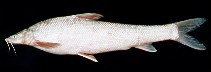
Diagnosed from other species of Barbus and Luciobarbus in Caspian Se basin by having the following characters: predorsal length shorter than postdorsal length; dorsal fin usually with 7½ branched rays; 16-25 gill rakers; back between head and dorsal origin laterally compressed, forming a keel; lateral line with 62-90 (usually 65-77) scales; and lower lip thin, without median lobe or pad (Ref. 59043).
Found in rivers, reservoirs, lakes and canals (Ref. 11145). Occurs in the sea at depths of up to 25 m and in rivers in deep stretches with gravel or stone bottom. In freshened parts of sea, preys mainly on benthic crustaceans. Does not feed while migrating upstream and starts to feed again at the spawning sites mainly on insects, juveniles of other fishes, rarely on algae, seeds and other plant material. Spawns in fast-flowing water at areas with hard bottom and depths of 1-2 m (Ref. 59043).
Eggs are semipelagic and hatch while drifting downstream after at least 2 days at 25°C. Larvae settle into places with slow current; after 2-12 months juveniles drift downstream to sea or reservoir if river is dammed (Ref. 59043).
Fricke, R., M. Bilecenoglu and H.M. Sari, 2007. Annotated checklist of fish and lamprey species (Gnathostoma and Petromyzontomorphi) of Turkey, including a Red List of threatened and declining species. Stuttgarter Beitr. Naturk. Sea A (706):1-172. (Ref. 58342)
IUCN Red List Status (Ref. 130435)
Threat to humans
Harmless
Human uses
Fisheries: commercial
More information
ReferencesAquacultureAquaculture profileStrainsGeneticsElectrophoresesHeritabilityDiseasesProcessingNutrientsMass conversion
Tools
Special reports
Download XML
Internet sources
Estimates based on models
Phylogenetic diversity index (Ref.
82804): PD
50 = 0.5000 [Uniqueness, from 0.5 = low to 2.0 = high].
Bayesian length-weight: a=0.01047 (0.00506 - 0.02166), b=3.00 (2.83 - 3.17), in cm total length, based on LWR estimates for this Genus-body shape (Ref.
93245).
Trophic level (Ref.
69278): 2.8 ±0.3 se; based on size and trophs of closest relatives
Generation time: 9.3 ( na - na) years. Estimated as median ln(3)/K based on 2
growth studies.
Resilience (Ref.
120179): Low, minimum population doubling time 4.5 - 14 years (K=0.12).
Fishing Vulnerability (Ref.
59153): High vulnerability (63 of 100).