Teleostei (teleosts) >
Perciformes/Cottoidei (Sculpins) >
Jordaniidae (Longfin sculpins)
Etymology: Scorpaenichthys: Latin, scorpaena = a kind of fish, 1706 + Greek, ichthys = fish (Ref. 45335).
More on author: Ayres.
Environment: milieu / climate zone / depth range / distribution range
Ecology
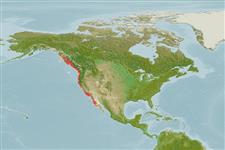
Marine; demersal; depth range 0 - 200 m (Ref. 2850). Subtropical; 58°N - 26°N, 137°W - 112°W
Eastern Pacific: Sitka, southeastern Alaska to Punta Abrejos, central Baja California, Mexico.
Size / Weight / Age
Maturity: Lm ? range ? - ? cm
Max length : 99.0 cm TL male/unsexed; (Ref. 2850); max. published weight: 14.0 kg (Ref. 27436); max. reported age: 13 years (Ref. 56049)
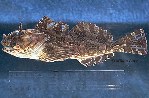
Inhabits rocky, sandy and muddy bottoms as well as kelp beds (Ref. 4925). Adults and juveniles feed on crustaceans, fishes and mollusks (Ref. 6885). Commonly captured by sport fishers (from shore, boats or piers) and by scuba divers (Ref. 2850). Flesh is good eating but eggs are poisonous and will make humans violently ill (Ref. 13513).
Eschmeyer, W.N., E.S. Herald and H. Hammann, 1983. A field guide to Pacific coast fishes of North America. Boston (MA, USA): Houghton Mifflin Company. xii+336 p. (Ref. 2850)
IUCN Red List Status (Ref. 130435)
Human uses
Fisheries: commercial; gamefish: yes; aquarium: public aquariums
More information
ReferencesAquacultureAquaculture profileStrainsGeneticsElectrophoresesHeritabilityDiseasesProcessingNutrientsMass conversion
Tools
Special reports
Download XML
Internet sources
Estimates based on models
Preferred temperature (Ref.
123201): 7.5 - 11.6, mean 8.9 °C (based on 40 cells).
Phylogenetic diversity index (Ref.
82804): PD
50 = 1.0000 [Uniqueness, from 0.5 = low to 2.0 = high].
Bayesian length-weight: a=0.00389 (0.00180 - 0.00842), b=3.12 (2.94 - 3.30), in cm total length, based on all LWR estimates for this body shape (Ref.
93245).
Trophic level (Ref.
69278): 3.6 ±0.47 se; based on food items.
Generation time: 3.2 ( na - na) years. Estimated as median ln(3)/K based on 1
growth studies.
Resilience (Ref.
120179): Medium, minimum population doubling time 1.4 - 4.4 years (tm=3; tmax=13; K=0.3, Fec=40,000-90,000).
Fishing Vulnerability (Ref.
59153): Moderate vulnerability (37 of 100).
Climate Vulnerability (Ref.
125649): Moderate vulnerability (44 of 100).
Nutrients (Ref.
124155): Calcium = 75.8 [30.9, 167.0] mg/100g; Iron = 0.974 [0.431, 2.041] mg/100g; Protein = 18.4 [16.2, 20.5] %; Omega3 = 0.314 [0.140, 0.892] g/100g; Selenium = 48.9 [24.8, 117.3] μg/100g; VitaminA = 6.13 [2.10, 17.38] μg/100g; Zinc = 0.592 [0.387, 0.936] mg/100g (wet weight);