Teleostei (teleosts) >
Carangiformes (Jacks) >
Carangidae (Jacks and pompanos) > Caranginae
Etymology: Selar: A Malay vernacular name, ikan selar.
More on author: Bloch.
Environment: milieu / climate zone / depth range / distribution range
Ecology
Marine; reef-associated; depth range 0 - 170 m (Ref. 9283), usually 2 - 10 m (Ref. 40849). Subtropical; 47°N - 31°S, 180°W - 180°E
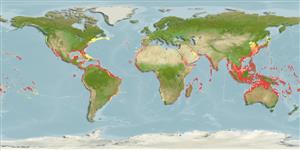
Circumtropical. Indo-Pacific: East Africa (Ref. 3287) to Rapa, north to southern Japan and the Hawaiian Islands, south to New Caledonia. Eastern Pacific: Mexico to Peru, including the Galapagos Islands (Ref. 5530). Western Atlantic: Nova Scotia, Canada and Bermuda through the Gulf of Mexico and the Caribbean to to São Paulo (Ref. 47377), Brazil. Eastern Atlantic: Cape Verde to southern Angola (Ref. 7097).
Length at first maturity / Size / Weight / Age
Maturity: Lm 17.7 range ? - ? cm
Max length : 70.0 cm TL male/unsexed; (Ref. 48635); max. reported age: 3.00 years (Ref. 104735)
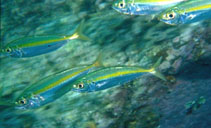
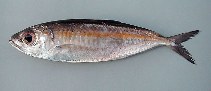
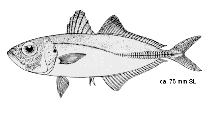
Adults prefer clear oceanic waters around islands to neritic waters (Ref. 5217). Occasionally in turbid waters (Ref. 9283). Pelagic (Ref. 58302). Individuals travel in compact groups of hundreds of thousands of fish. Mainly nocturnal in habit, they disperse at night to feed on small shrimps, benthic invertebrates, and forams when inshore, and zooplankton and fish larvae when offshore (Ref. 9283, 90102). Marketed fresh and salted or dried (Ref. 9283). Reported to reach 70 cm TL (Ref. 48635).
Smith-Vaniz, W.F., 1995. Carangidae. Jureles, pámpanos, cojinúas, zapateros, cocineros, casabes, macarelas, chicharros, jorobados, medregales, pez pilota. p. 940-986. In W. Fischer, F. Krupp, W. Schneider, C. Sommer, K.E. Carpenter and V. Niem (eds.) Guia FAO para Identification de Especies para lo Fines de la Pesca. Pacifico Centro-Oriental. 3 Vols. FAO, Rome. (Ref. 9283)
IUCN Red List Status (Ref. 130435)
Threat to humans
Reports of ciguatera poisoning (Ref. 30911)
Human uses
Fisheries: highly commercial; gamefish: yes; bait: usually
Tools
Special reports
Download XML
Internet sources
Estimates based on models
Preferred temperature (Ref.
123201): 20 - 29.2, mean 27.9 °C (based on 6848 cells).
Phylogenetic diversity index (Ref.
82804): PD
50 = 0.7500 [Uniqueness, from 0.5 = low to 2.0 = high].
Bayesian length-weight: a=0.01349 (0.01201 - 0.01516), b=2.98 (2.95 - 3.01), in cm total length, based on LWR estimates for this species (Ref.
93245).
Trophic level (Ref.
69278): 3.8 ±0.2 se; based on diet studies.
Resilience (Ref.
120179): High, minimum population doubling time less than 15 months (K=0.6-0.9).
Prior r = 1.19, 95% CL = 0.79 - 1.79, Based on 8 stock assessments.
Fishing Vulnerability (Ref.
59153): Moderate vulnerability (39 of 100).
Climate Vulnerability (Ref.
125649): High vulnerability (60 of 100).
Nutrients (Ref.
124155): Calcium = 44.7 [14.5, 96.7] mg/100g; Iron = 0.976 [0.355, 2.254] mg/100g; Protein = 21.2 [19.1, 23.1] %; Omega3 = 0.331 [0.165, 0.686] g/100g; Selenium = 51.7 [18.8, 141.0] μg/100g; VitaminA = 15.1 [3.9, 70.2] μg/100g; Zinc = 0.678 [0.337, 1.145] mg/100g (wet weight); based on
nutrient studies.