Teleostei (teleosts) >
Cypriniformes (Carps) >
Danionidae (Danios) > Rasborinae
Etymology: Rasbora: Rasbora, an Indian word for a fish, also used in Malay peninsula.
Environment: milieu / climate zone / depth range / distribution range
Ecology
Freshwater; benthopelagic. Tropical
Asia: Chao Phraya and Mekong basins (Ref. 12693). Reported from Maeklong River (Ref. 26336).
Size / Weight / Age
Maturity: Lm ? range ? - ? cm
Max length : 15.0 cm SL male/unsexed; (Ref. 30857)
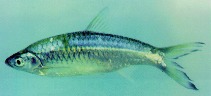
Depth 3.1-4.2 times in SL; lateral line complete; pale in color with distinctive neon green stripe running above dark mid-lateral streak when alive (Ref. 12693). Dorsal fin origin closer to caudal fin base than eye; caudal fin bright yellow in life, with black posterior margin (Ref. 43281).
Occur near the surface of ponds, canals and streams. Often found in turbid waters. Probably feed mostly on exogenous insects and also on some algae. Spawning sites are found in rivers and ponds (Ref. 33813). Mature adults probably breed during the rainy season. Occasionally sold fresh. Probably used to make prahoc (Ref. 12693).
Life cycle and mating behavior
Maturity | Reproduction | Spawning | Eggs | Fecundity | Larvae
Rainboth, W.J., 1996. Fishes of the Cambodian Mekong. FAO species identification field guide for fishery purposes. FAO, Rome, 265 p. (Ref. 12693)
IUCN Red List Status (Ref. 130435)
Threat to humans
Harmless
Human uses
Fisheries: commercial
More information
ReferencesAquacultureAquaculture profileStrainsGeneticsElectrophoresesHeritabilityDiseasesProcessingNutrientsMass conversion
Tools
Special reports
Download XML
Internet sources
Estimates based on models
Phylogenetic diversity index (Ref.
82804): PD
50 = 0.5000 [Uniqueness, from 0.5 = low to 2.0 = high].
Bayesian length-weight: a=0.00468 (0.00189 - 0.01159), b=3.08 (2.86 - 3.30), in cm total length, based on LWR estimates for this (Sub)family-body shape (Ref.
93245).
Trophic level (Ref.
69278): 2.6 ±0.28 se; based on food items.
Resilience (Ref.
120179): Medium, minimum population doubling time 1.4 - 4.4 years (Preliminary K or Fecundity.).
Fishing Vulnerability (Ref.
59153): Low vulnerability (10 of 100).