Issue
This species is synonym of Makaira nigricans Lacepède, 1802 in Eschmeyer (CofF ver. Jan. 2012: Ref. 89336) following Collette et al. (2006) and Bray et al. (2006). The species page will be removed.
Environment: milieu / climate zone / depth range / distribution range
Ecology
Marine; pelagic-oceanic; oceanodromous (Ref. 51243); depth range 0 - 200 m (Ref. 43), usually 100 - ? m (Ref. 6390). Subtropical; 21°C - ? (Ref. 30368); 44°N - 40°S, 30°E - 74°W (Ref. 43)
Indo-Pacific: in tropical, subtropical and sometimes temperate waters (Ref. 9692). It is the most tropical billfish species and is common in equatorial waters. However, many scientists do not view Makaira mazara and Makaira nigricans as distinct species, and that the latter species has been considered as a single pantropical species occurring in the Atlantic, Pacific and Indian Oceans. Highly migratory species.
Length at first maturity / Size / Weight / Age
Maturity: Lm ? range ? - ? cm
Max length : 500 cm TL male/unsexed; (Ref. 30874); common length : 350 cm TL male/unsexed; (Ref. 9308); max. published weight: 170.0 kg (Ref. 6390); max. published weight: 170.0 kg; max. reported age: 28 years (Ref. 30371)
Dorsal
soft rays
(total): 40-45;
Anal
soft rays: 18 - 24;
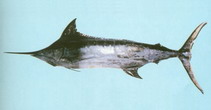
Vertebrae: 24. Body elongated and not very compressed; upper jaw produced into a robust but not very long beak; two dorsal fins, the height of the first less then the greatest body depth, short anteriorly, taller in the middle, then becoming shorter posteriorly; pectoral fins falcate and flexible, with 21 to 23 rays; body densely covered with small, embedded scales with 1 or 2 sharp points; back dark blue, with 15 bluish bars across the flanks; belly pale silver; membrane of first dorsal fin blue black, with dark spots (Ref. 55763). Dark blue above, silvery white below; sometimes with light blue vertical stripes; 1st dorsal fin blackish to dark blue, other fins dark brown with tinges of dark blue in some specimens. Body blue-black dorsally and silvery white ventrally, with about 25 pale, cobalt-colored stripes, each consisting of round dots or narrow bars (may not always be visible especially in preserved specimens). Bill long, extremely stout and round in cross section. Nape conspicuously elevated. Right and left branchiostegal membranes completely united together, but free from isthmus. No gill rakers. Body densely covered with elongate, thick, bony scales, each often with 1 or 2, sometimes 3, posterior points. Caudal peduncle with strong double keels on each side and a shallow notch on both the dorsal and ventral surfaces.
Epipelagic and oceanic species mostly confined to the waters on the warmer side of the 24°C surface isotherm and known to effect seasonal north-south migrations. Not usually seen close to land masses or islands, unless there is a deep drop-off of the shelf. Remain mostly within the upper 37 m. Believed to form small-scale schools of at most 10 individuals. Larger fish tend to swim solitarily (Ref. 43) but smaller ones form schools of about 10 individuals (Ref. 9987). Feed on squids, tuna-like fishes, crustaceans and cephalopods (Ref. 9308). Also caught with troll lines (Ref. 9308). The flesh is of good quality and is marketed frozen and prepared as sashimi and sausages in Japan (Ref. 9308); also utilized fresh (Ref. 9987). Also Ref. 9692.
Spawning probably takes place year-round in equatorial waters to 10° latitude (although 1 study has suggested this needs verification) and during summer periods in both hemispheres to 30° latitude, in both the Indian and Pacific oceans (Ref. 6390).
In the southern hemisphere, concentrations of spawning fish probably occur around French Polynesia (Ref. 30354).
Nakamura, I., 1985. FAO species catalogue. Vol. 5. Billfishes of the world. An annotated and illustrated catalogue of marlins, sailfishes, spearfishes and swordfishes known to date. FAO Fish. Synop. 125(5):65p. Rome: FAO. (Ref. 43)
IUCN Red List Status (Ref. 130435)
Threat to humans
Harmless
Human uses
Fisheries: commercial; gamefish: yes
Tools
Special reports
Download XML
Internet sources
Estimates based on models
Preferred temperature (Ref.
123201): 13.6 - 25.2, mean 19.3 °C (based on 408 cells).
Phylogenetic diversity index (Ref.
82804): PD
50 = 0.7505 [Uniqueness, from 0.5 = low to 2.0 = high].
Bayesian length-weight: a=0.00447 (0.00193 - 0.01034), b=3.14 (2.94 - 3.34), in cm total length, based on LWR estimates for this (Sub)family-body shape (Ref.
93245).
Trophic level (Ref.
69278): 4.5 ±0.89 se; based on food items.
Generation time: 9.5 ( na - na) years. Estimated as median ln(3)/K based on 1
growth studies.
Resilience (Ref.
120179): Low, minimum population doubling time 4.5 - 14 years (rm=0.104; K=0.12-0.29; tm=4; tmax=28; Fec=31 million).
Fishing Vulnerability (Ref.
59153): High to very high vulnerability (70 of 100).
Climate Vulnerability (Ref.
125649): Very high vulnerability (84 of 100).
Nutrients (Ref.
124155): Calcium = 21.5 [10.2, 35.8] mg/100g; Iron = 0.804 [0.465, 1.353] mg/100g; Protein = 19.6 [18.5, 20.7] %; Omega3 = 0.197 [0.102, 0.367] g/100g; Selenium = 49.6 [25.5, 95.2] μg/100g; VitaminA = 5.18 [1.68, 16.00] μg/100g; Zinc = 0.331 [0.229, 0.481] mg/100g (wet weight);