Teleostei (teleosts) >
Kurtiformes (Nurseryfishes, cardinalfishes.) >
Apogonidae (Cardinalfishes) > Apogoninae
Etymology: Pterapogon: Greek, pteron = wing, fin + Greek, pogon = beard (Ref. 45335).
Environment: milieu / climate zone / depth range / distribution range
Ecology
Marine; demersal; depth range 0 - 16 m (Ref. 90102), usually 1 - 2 m (Ref. 9936). Tropical; 1°S - 2°S, 123°E - 124°E
Western Pacific: Apparently restricted to Banggai Islands, Indonesia. Also found in several small islands off nearby eastern Taliabu Island and Luwuk vicinity (Ref. 90102). Threatened by extinction due to collection for the aquarium trade (Ref. 27438, 35396).
Length at first maturity / Size / Weight / Age
Maturity: Lm 4.1 range ? - ? cm
Max length : 8.6 cm TL (female); max. published weight: 0.00 g
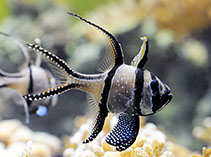
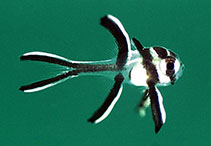
Common around the jetty, in silty sand bottoms with seagrass (Enhalus acoroides). Associated with Diadema setosum, the long-spined sea urchins. Individuals of 2 to 60 hover directly above the urchins, with the younger ones about 2-3 cm SL staying closer to the urchins. The fish retreat among the spines when threatened. Probably feed on small benthic and planktonic crustaceans at night. Male incubates the eggs until hatching; the large egg about 2.5 mm in diameter, with the young remaining within the mouth cavity for undetermined period after hatching (Ref. 9936, 48635). Newly hatched larvae have no planktonic period (Ref. 35886). Juveniles also use anemones for protection (Ref. 45560, 48635). Has been reared in captivity (Ref. 35417).
The male takes the eggs into its mouth where these and the larvae remain until young fish of about 8mm SL are released. Distinct pairing during courtship and spawning (Ref. 205). Also Ref. 240.
Allen, G.R. and R.C. Steene, 1995. Notes on the ecology and behaviour of the Indonesian cardinalfish (Apogonidae) Pterapogon kauderni Koumans. Rev. Fr. Aquariol. 22(1-2):7-10. (Ref. 9936)
IUCN Red List Status (Ref. 130435)
Threat to humans
Harmless
Human uses
Fisheries: of no interest; aquarium: commercial
More information
ReferencesAquacultureAquaculture profileStrainsGeneticsElectrophoresesHeritabilityDiseasesProcessingNutrientsMass conversion
Tools
Special reports
Download XML
Internet sources
Estimates based on models
Phylogenetic diversity index (Ref.
82804): PD
50 = 1.0000 [Uniqueness, from 0.5 = low to 2.0 = high].
Bayesian length-weight: a=0.01862 (0.01022 - 0.03394), b=2.94 (2.78 - 3.10), in cm total length, based on LWR estimates for this species & (Sub)family-body (Ref.
93245).
Trophic level (Ref.
69278): 3.3 ±0.41 se; based on food items.
Generation time: 1.5 ( na - na) years. Estimated as median ln(3)/K based on 1
growth studies.
Resilience (Ref.
120179): Medium, minimum population doubling time 1.4 - 4.4 years (tm<1; Fec=12-40; assuming multiple spawning).
Fishing Vulnerability (Ref.
59153): Low vulnerability (19 of 100).