Teleostei (teleosts) >
Syngnathiformes (Pipefishes and seahorses) >
Syngnathidae (Pipefishes and seahorses) > Syngnathinae
Etymology: Hippocampus: Greek, ippos = horse + Greek,kampe = curvature (Ref. 45335); angustus: Name from Latin for large and head, referring to its head which is proportionally larger than most other Hippocampus species..
More on author: Günther.
Environment: milieu / climate zone / depth range / distribution range
Ecology
Marine; reef-associated; non-migratory; depth range 3 - 63 m (Ref. 30915). Tropical; 10°S - 24°S
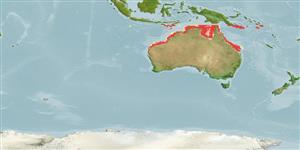
Indo-West Pacific: Australia (Western Australia to Queensland).
Length at first maturity / Size / Weight / Age
Maturity: Lm 7.8 range ? - ? cm
Max length : 22.0 cm TL male/unsexed; (Ref. 3132)
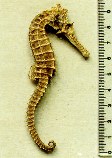
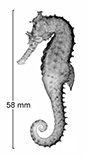
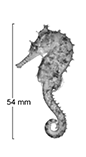
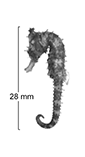
Found in sheltered bays. Color varies from either white, orange or yellow with light patches and sometimes network of fine dark lines; also with narrow lines across snout. Ovoviviparous (Ref. 205), monogamous (Ref. 36642). The male carries the eggs in a brood pouch which is found under the tail (Ref. 205).
Life cycle and mating behavior
Maturity | Reproduction | Spawning | Eggs | Fecundity | Larvae
Male carries the eggs in a brood pouch (Ref. 205, 53335).
Lourie, S.A., R.A. Pollom and S.J. Foster, 2016. A global revision of the seahorses Hippocampus Rafinesque 1810 (Actinopterygii: Syngnathiformes): taxonomy and biogeography with recommendations for further research. Zootaxa 4146(1):1-66. (Ref. 115213)
IUCN Red List Status (Ref. 130435)
Threat to humans
Harmless
Human uses
Fisheries: minor commercial; aquarium: public aquariums
More information
Age/SizeGrowthLength-weightLength-lengthLength-frequenciesMorphometricsMorphologyLarvaeLarval dynamicsRecruitmentAbundanceBRUVS
ReferencesAquacultureAquaculture profileStrainsGeneticsElectrophoresesHeritabilityDiseasesProcessingNutrientsMass conversion
Tools
Special reports
Download XML
Internet sources
Estimates based on models
Preferred temperature (Ref.
123201): 26.1 - 28.6, mean 27.5 °C (based on 248 cells).
Phylogenetic diversity index (Ref.
82804): PD
50 = 0.5000 [Uniqueness, from 0.5 = low to 2.0 = high].
Bayesian length-weight: a=0.00447 (0.00177 - 0.01127), b=3.00 (2.78 - 3.22), in cm total length, based on LWR estimates for this (Sub)family-body shape (Ref.
93245).
Trophic level (Ref.
69278): 3.5 ±0.5 se; based on size and trophs of closest relatives
Resilience (Ref.
120179): High, minimum population doubling time less than 15 months (Preliminary K or Fecundity.).
Fishing Vulnerability (Ref.
59153): Low vulnerability (12 of 100).
Nutrients (Ref.
124155): Calcium = 88.7 [51.1, 161.2] mg/100g; Iron = 0.756 [0.458, 1.358] mg/100g; Protein = 18 [17, 19] %; Omega3 = 0.119 [0.071, 0.207] g/100g; Selenium = 39.9 [21.4, 83.4] μg/100g; VitaminA = 69.9 [23.5, 192.9] μg/100g; Zinc = 1.46 [1.02, 2.03] mg/100g (wet weight);