Environment: milieu / climate zone / depth range / distribution range
Ecology
Marine; brackish; reef-associated; depth range 0 - 53 m (Ref. 13608), usually ? - 4 m (Ref. 55205). Subtropical; 36°N - 4°S, 100°W - 37°W (Ref. 55205)
Western Atlantic: New Jersey, USA and northern Gulf of Mexico to southern Brazil, including the Antilles (Ref. 3168).
Length at first maturity / Size / Weight / Age
Maturity: Lm 81.3, range 75 - 80 cm
Max length : 200 cm WD male/unsexed; (Ref. 3168); common length : 90.0 cm WD male/unsexed; (Ref. 3168); max. published weight: 135.6 kg (Ref. 40637); max. reported age: 28 years (Ref. 53968)
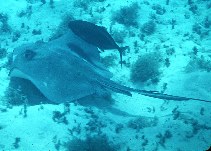
Disk has sharp outer corners and irregular row of short spines on upper surface (Ref. 26938). Disk usually uniform dark brown above, grayer in young. Ventral finfold on tail long and high, dorsal finfold absent (Ref. 7251). Upper surface of disc gray, dark or olivaceous brown or olive green. Lower surface of disc white or whitish with an edging of gray or brown (Ref. 6902).
Found on sandy bottoms, seagrass beds, lagoons and the reef face (Ref. 12951). Common in bays and estuaries (Ref. 7251). Observed singly, in pairs and in aggregations (Ref. 12951). Buries in the sand during the day and forages at night, usually in seagrass beds (Ref. 12951). Feeds mainly on bivalves and worms and also takes shrimps, crabs and small fishes (Ref. 3168). Feeds by creating depressions in the sand to expose invertebrates and small fishes (Ref. 9710). Ovoviviparous, with 3-4 in a litter (Ref. 12951). May be found in cleaning stations where they are attended to by the bluehead wrasse and Spanish hogfish (Ref. 12951). Equipped with a well-developed serrated spine and capable of inflicting a painful laceration. Easily approached by divers (Ref. 9710).
Life cycle and mating behavior
Maturity | Reproduction | Spawning | Eggs | Fecundity | Larvae
Exhibit ovoviparity (aplacental viviparity), with embryos feeding initially on yolk, then receiving additional nourishment from the mother by indirect absorption of uterine fluid enriched with mucus, fat or protein through specialised structures (Ref. 50449). Distinct pairing with embrace (Ref. 205). Male mounts on female dorsally (Ref. 12951).
Last, P.R., W.T. White, M.R. de Carvalho, B. Séret, M.F.W. Stehmann and G.J.P. Naylor, 2016. Rays of the world. CSIRO Publishing, Comstock Publishing Associates. i-ix + 1-790. (Ref. 114953)
IUCN Red List Status (Ref. 130435)
Threat to humans
Traumatogenic (Ref. 4690)
Human uses
Fisheries: commercial; gamefish: yes
Tools
Special reports
Download XML
Internet sources
Estimates based on models
Preferred temperature (Ref.
123201): 23.7 - 28.1, mean 27.3 °C (based on 795 cells).
Phylogenetic diversity index (Ref.
82804): PD
50 = 0.5039 [Uniqueness, from 0.5 = low to 2.0 = high].
Bayesian length-weight: a=0.00646 (0.00265 - 0.01571), b=3.06 (2.86 - 3.26), in cm total length, based on LWR estimates for this (Sub)family-body shape (Ref.
93245).
Trophic level (Ref.
69278): 3.5 ±0.0 se; based on diet studies.
Resilience (Ref.
120179): Low, minimum population doubling time 4.5 - 14 years (tmax=28; Fec=3-4).
Fishing Vulnerability (Ref.
59153): Very high vulnerability (90 of 100).
Nutrients (Ref.
124155): Calcium = 5.41 [0.65, 23.15] mg/100g; Iron = 0.355 [0.083, 0.950] mg/100g; Protein = 24.6 [21.7, 27.3] %; Omega3 = 0.145 [0.039, 0.464] g/100g; Selenium = 13.9 [4.1, 41.6] μg/100g; VitaminA = 19.8 [6.4, 64.3] μg/100g; Zinc = 0.592 [0.287, 1.207] mg/100g (wet weight);