Teleostei (teleosts) >
Acanthuriformes (Surgeonfishes) >
Siganidae (Rabbitfishes)
Etymology: Siganus: Latin, siganus = a fish, rabbit fish; by the similarity of the nose (Ref. 45335).
More on author: Linnaeus.
Environment: milieu / climate zone / depth range / distribution range
Ecology
Marine; reef-associated; depth range 1 - 50 m (Ref. 28016), usually 1 - 20 m (Ref. 27115). Tropical; 24°C - 28°C (Ref. 27115); 30°N - 30°S, 77°E - 129°W
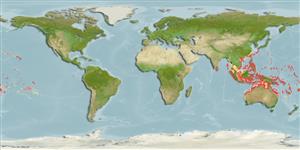
Indo-West Pacific: Known from India to French Polynesia; north to Japan; south to New Caledonia.
Size / Weight / Age
Maturity: Lm ? range ? - ? cm
Max length : 28.0 cm TL male/unsexed; (Ref. 9710); common length : 18.0 cm TL male/unsexed; (Ref. 9813)
Dorsal
spines
(total): 13;
Dorsal
soft rays
(total): 10;
Anal
spines: 7;
Anal
soft rays: 9;
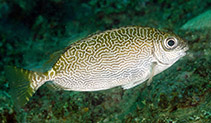
Vertebrae: 13. The species can adopt a number of camouflage patterns involving off-white, pale gray to blackish, and various shades of brown. The basic pattern consists of a labyrinth of narrow bands with upper half vermiculate, the lower ones tend to meander horizontally. This pattern extends to the fins. Iris golden dissected by a chocolate cross. 4-5 irregular off-white bars on caudal peduncle. Scales fine on cheeks, densely packed over lower 2/3 of preopercular region. Midline of thorax without scales between pelvic ridges. Fin spines stout, pungent, venomous. Preopercular angle 87-100 degrees.
Adults inhabit shallow coral reef flats. Found in rivers (Ref. 12792, 48637). Occurs in small schools (usually less than 10 individuals). Juveniles gather in larger numbers in corals with algae-grown at their bases (Ref. 48637). Initially, they browse on fine textured, e.g. filamentous algae, switching to coarser algae with increasing size. Both adults and juveniles are diurnal feeders (Ref. 4666). Fry are marketed fresh, pickled in brine or made into fish paste (Ref. 9813). Can inflict painful stings (Ref. 4690).
Life cycle and mating behavior
Maturity | Reproduction | Spawning | Eggs | Fecundity | Larvae
Woodland, D.J., 1990. Revision of the fish family Siganidae with descriptions of two new species and comments on distribution and biology. Indo-Pac. Fish. (19):136 p. (Ref. 1419)
IUCN Red List Status (Ref. 130435)
Human uses
Fisheries: minor commercial; aquarium: commercial
Tools
Special reports
Download XML
Internet sources
Estimates based on models
Preferred temperature (Ref.
123201): 24.6 - 29, mean 28 °C (based on 950 cells).
Phylogenetic diversity index (Ref.
82804): PD
50 = 0.5000 [Uniqueness, from 0.5 = low to 2.0 = high].
Bayesian length-weight: a=0.01950 (0.01284 - 0.02961), b=3.01 (2.89 - 3.13), in cm total length, based on LWR estimates for this species & Genus-body shape (Ref.
93245).
Trophic level (Ref.
69278): 2.0 ±0.03 se; based on food items.
Generation time: 0.5 ( na - na) years. Estimated as median ln(3)/K based on 1
growth studies.
Resilience (Ref.
120179): High, minimum population doubling time less than 15 months (Preliminary K or Fecundity.).
Prior r = 1.20, 95% CL = 0.79 - 1.80, Based on 1 stock assessment.
Fishing Vulnerability (Ref.
59153): Low vulnerability (14 of 100).
Nutrients (Ref.
124155): Calcium = 64 [32, 208] mg/100g; Iron = 1.26 [0.58, 2.88] mg/100g; Protein = 19 [17, 21] %; Omega3 = 0.139 [0.060, 0.322] g/100g; Selenium = 43.8 [15.1, 113.6] μg/100g; VitaminA = 16.7 [3.8, 80.7] μg/100g; Zinc = 2.22 [0.81, 4.57] mg/100g (wet weight);