Teleostei (teleosts) >
Osteoglossiformes (Bony tongues) >
Notopteridae (Featherbacks or knifefishes) > Notopterinae
Etymology: Chitala: Bangladesh local name; chitala: From rivers of Bengal & Behar..
More on author: Hamilton.
Environment: milieu / climate zone / depth range / distribution range
Ecology
Freshwater; demersal; pH range: 6.0 - 8.0; dH range: 5 - 19. Tropical; 24°C - 28°C (Ref. 2060)
Asia: Indus, Ganges-Brahmaputra and Mahanadi river basins in India. No valid records from Irrawaddy, Salween or other river basins of Myanmar. Reports of Chitala chitala from Thailand and Indo-China were based on Chitala ornata and those from Malaysia and Indonesia on Chitala lopis.
Length at first maturity / Size / Weight / Age
Maturity: Lm 75.5 range ? - 91 cm
Max length : 122 cm SL male/unsexed; (Ref. 4832); common length : 75.0 cm SL male/unsexed; (Ref. 2686)
Short description
Morphology | Morphometrics
Dorsal
spines
(total): 0;
Dorsal
soft rays
(total): 9;
Anal
spines: 0;
Anal
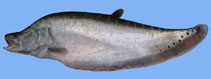
soft rays: 117 - 127. The only species in which subadults and adults have a series of transverse gold or silver bars on the dorsum, but this color feature is not always present (Ref. 7431). Differs from C. ornata in never having ocellated spots and from C. blanci and C. lopis in never having a black spot on the pectoral fin base (Ref. 7431).
Facultative air-breathing (Ref. 126274); Adults inhabit freshwater rivers, lakes, beels, nullahs in the plains (Ref. 41236), reservoirs, canals and ponds (Ref. 1479). Feed on aquatic insects, mollusks, shrimps and small fishes (Ref. 1479). Females lay eggs usually on stake or stump of wood, males fan them with tail, keep them aerated and silt-free, guard them against small catfish and other predators; complete give-away to fishermen; females not observed at egg posts; moderately important food fish (Ref. 2686). Spawn once a year during May to August (Ref. 6459).
Life cycle and mating behavior
Maturity | Reproduction | Spawning | Eggs | Fecundity | Larvae
The male tends the clutch (Ref. 2060).
Roberts, T.R., 1992. Systematic revision of the old world freshwater fish family Notopteridae. Ichthyol. Explor. Freshwat. 2(4):361-383. (Ref. 7431)
IUCN Red List Status (Ref. 130435)
Threat to humans
Harmless
Human uses
Fisheries: minor commercial; aquaculture: commercial; gamefish: yes; aquarium: commercial
Tools
Special reports
Download XML
Internet sources
Estimates based on models
Phylogenetic diversity index (Ref.
82804): PD
50 = 0.5166 [Uniqueness, from 0.5 = low to 2.0 = high].
Bayesian length-weight: a=0.01259 (0.00522 - 0.03035), b=3.05 (2.83 - 3.27), in cm total length, based on LWR estimates for this (Sub)family-body shape (Ref.
93245).
Trophic level (Ref.
69278): 3.7 ±0.59 se; based on food items.
Generation time: 3.7 ( na - na) years. Estimated as median ln(3)/K based on 1
growth studies.
Resilience (Ref.
120179): Medium, minimum population doubling time 1.4 - 4.4 years (tm=2).
Fishing Vulnerability (Ref.
59153): Moderate to high vulnerability (48 of 100).
Nutrients (Ref.
124155): Calcium = 72.1 [24.2, 211.9] mg/100g; Iron = 1.51 [0.55, 3.74] mg/100g; Protein = 17.4 [15.7, 19.1] %; Omega3 = 0.358 [0.132, 0.991] g/100g; Selenium = 104 [32, 279] μg/100g; VitaminA = 17.1 [3.8, 70.3] μg/100g; Zinc = 0.686 [0.386, 1.490] mg/100g (wet weight); based on
nutrient studies.