Teleostei (teleosts) >
Carangiformes (Jacks) >
Carangidae (Jacks and pompanos) > Caranginae
Etymology: Caranx: French, carangue, the name of a Caribbean fish; 1836 (Ref. 45335).
More on author: Poey.
Environment: milieu / climate zone / depth range / distribution range
Ecology
Marine; benthopelagic; oceanodromous (Ref. 51243); depth range 12 - 354 m (Ref. 9710), usually 24 - 65 m (Ref. 5217). Subtropical; 30°N - 30°S, 180°W - 180°E
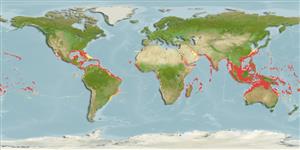
Circumtropical. Western Indian Ocean: off Natal and East London in South Africa (Ref. 3197, 11228); Reunion, Mauritius and Cargados Carajos (Ref. 33390); Seychelles (Ref. 10685). Western Pacific: southern Japan to New Caledonia. Recently reported from Tonga (Ref. 53797). Western Atlantic: Bermuda and the northern Gulf of Mexico to Brazil. Eastern Atlantic: Azores, Madeira, St. Paul's Rocks (Ref. 13121), Ascension Island, Cape Verde, and Gulf of Guinea. Eastern Central Pacific: Mexico (including Revillagigedo Islands) to Costa Rica.
Length at first maturity / Size / Weight / Age
Maturity: Lm ?, range 38 - ? cm
Max length : 100.0 cm TL male/unsexed; (Ref. 7251); common length : 70.0 cm TL male/unsexed; (Ref. 5217); max. published weight: 17.9 kg (Ref. 40637)
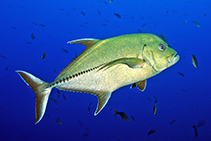
An oceanic and insular species, very much restricted to clear oceanic waters (Ref. 9283). Not commonly found in shallow banks (Ref. 9283). Sometimes seen near drop-off at outer edge of reefs (Ref. 26938). Occasionally forming schools. Feed on fishes at night (Ref. 5213). Eggs are pelagic (Ref. 4233). Marketed mainly fresh, also dried or salted (Ref. 9283).
Life cycle and mating behavior
Maturity | Reproduction | Spawning | Eggs | Fecundity | Larvae
Paxton, J.R., D.F. Hoese, G.R. Allen and J.E. Hanley, 1989. Pisces. Petromyzontidae to Carangidae. Zoological Catalogue of Australia, Vol. 7. Australian Government Publishing Service, Canberra, 665 p. (Ref. 7300)
IUCN Red List Status (Ref. 130435)
Threat to humans
Reports of ciguatera poisoning (Ref. 9710)
Human uses
Fisheries: minor commercial; aquaculture: commercial; gamefish: yes
More information
ReferencesAquacultureAquaculture profileStrainsGeneticsElectrophoresesHeritabilityDiseasesProcessingNutrientsMass conversion
Tools
Special reports
Download XML
Internet sources
Estimates based on models
Preferred temperature (Ref.
123201): 21 - 28.4, mean 27.1 °C (based on 1117 cells).
Phylogenetic diversity index (Ref.
82804): PD
50 = 0.5000 [Uniqueness, from 0.5 = low to 2.0 = high].
Bayesian length-weight: a=0.01738 (0.01424 - 0.02120), b=2.95 (2.92 - 2.98), in cm total length, based on LWR estimates for this species (Ref.
93245).
Trophic level (Ref.
69278): 4.5 ±0.8 se; based on diet studies.
Generation time: 9.2 ( na - na) years. Estimated as median ln(3)/K based on 1
growth studies.
Resilience (Ref.
120179): Low, minimum population doubling time 4.5 - 14 years (K=0.12).
Prior r = 0.27, 95% CL = 0.16 - 0.47, Based on 1 stock assessment.
Fishing Vulnerability (Ref.
59153): High vulnerability (60 of 100).
Nutrients (Ref.
124155): Calcium = 18.6 [8.7, 42.6] mg/100g; Iron = 0.471 [0.233, 0.996] mg/100g; Protein = 19.2 [16.8, 21.7] %; Omega3 = 0.326 [0.167, 0.626] g/100g; Selenium = 49.4 [20.4, 117.3] μg/100g; VitaminA = 20.6 [5.9, 67.4] μg/100g; Zinc = 0.309 [0.207, 0.482] mg/100g (wet weight);