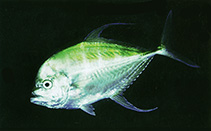
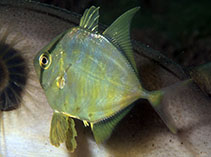
Classification / Names
Common names | Synonyms | Catalog of Fishes(genus, species) | ITIS | CoL | WoRMS | Cloffa
Teleostei (teleosts) >
Carangiformes (Jacks) >
Carangidae (Jacks and pompanos) > Caranginae
Etymology: Atropus: The name of the Parcae, fates of Roman mythology (Ref. 45335).
Environment: milieu / climate zone / depth range / distribution range
Ecology
Marine; brackish; reef-associated; depth range 1 - 59 m (Ref. 99978). Tropical; 32°N - 30°S, 33°E - 134°E
Indo-West Pacific: Red Sea, Gulf of Oman and along the African coast (to East London in South Africa, Ref. 3197) and the west coast of Madagascar to southern India and Sri Lanka. There are reliable reports from the Gulf of Thailand, Hong Kong, Okinawa and Japan.
Size / Weight / Age
Maturity: Lm ? range ? - ? cm
Max length : 58.0 cm TL male/unsexed; (Ref. 90102); common length : 30.0 cm TL male/unsexed; (Ref. 5450); max. published weight: 3.5 kg (Ref. 4883)
Adults are found in coastal waters near corals and rocks, also in shallow lagoons (Ref. 30573). Solitary species on inshore reefs (Ref. 48635). Small groups frequently patrol perimeter of reefs (Ref. 90102). Juveniles may enter estuaries (Ref. 5213). Behaviour of shadowing a larger fish was observed, expected to be more common for juvenies (B. Hazes, pers. comm. 3/2023).
Life cycle and mating behavior
Maturity | Reproduction | Spawning | Eggs | Fecundity | Larvae
Smith-Vaniz, W.F., 1984. Carangidae. In W. Fischer and G. Bianchi (eds.) FAO species identification sheets for fishery purposes. Western Indian Ocean fishing area 51. Vol. 1. [pag. var.]. FAO, Rome. (Ref. 3287)
IUCN Red List Status (Ref. 130435)
Threat to humans
Harmless
Human uses
Fisheries: commercial; gamefish: yes
More information
Common namesSynonymsMetabolismPredatorsEcotoxicologyReproductionMaturitySpawningSpawning aggregationFecundityEggsEgg development
Tools
Special reports
Download XML
Internet sources
Estimates based on models
Preferred temperature (Ref.
123201): 24.7 - 29.2, mean 28.4 °C (based on 1300 cells).
Phylogenetic diversity index (Ref.
82804): PD
50 = 0.5000 [Uniqueness, from 0.5 = low to 2.0 = high].
Bayesian length-weight: a=0.01950 (0.01182 - 0.03218), b=2.94 (2.81 - 3.07), in cm total length, based on LWR estimates for this species & Genus-body shape (Ref.
93245).
Trophic level (Ref.
69278): 4.1 ±0.57 se; based on food items.
Resilience (Ref.
120179): Medium, minimum population doubling time 1.4 - 4.4 years (Preliminary K or Fecundity.).
Fishing Vulnerability (Ref.
59153): Moderate vulnerability (43 of 100).
Nutrients (Ref.
124155): Calcium = 28.7 [17.2, 71.2] mg/100g; Iron = 1.22 [0.56, 2.60] mg/100g; Protein = 20.4 [17.9, 22.5] %; Omega3 = 0.183 [0.098, 0.348] g/100g; Selenium = 8.69 [4.05, 19.31] μg/100g; VitaminA = 86.2 [14.0, 513.0] μg/100g; Zinc = 0.708 [0.375, 1.538] mg/100g (wet weight);