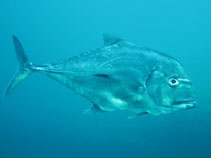
Teleostei (teleosts) >
Carangiformes (Jacks) >
Carangidae (Jacks and pompanos) > Caranginae
Etymology: Alectis: One of three Erinyes in the Greek mythology; daughter of Acheronte with a terrible rage.
More on author: Bloch.
Environment: milieu / climate zone / depth range / distribution range
Ecology
Marine; reef-associated; depth range 60 - 100 m (Ref. 37816). Subtropical; 42°N - 34°S, 180°W - 180°E
Circumglobal in tropical, subtropical and temperate seas. Western Atlantic: Massachusetts, USA and Bermuda to Santos, Brazil; throughout the Caribbean Sea and the Gulf of Mexico (Ref. 9626). Eastern Atlantic: Senegal to Congo. Western Indian Ocean: Red Sea to Algoa Bay, South Africa and to Sri Lanka (Ref. 3197, 3287). Eastern Pacific: Mexico to Peru.
Size / Weight / Age
Maturity: Lm ? range ? - ? cm
Max length : 150 cm TL male/unsexed; (Ref. 30573); common length : 100.0 cm FL male/unsexed; (Ref. 30573); max. published weight: 22.9 kg (Ref. 40637)
Pelagic in neritic and oceanic waters, sometimes near the bottom (Ref. 5217, 58302). Small juveniles may be found near the shore (Ref. 5217); adults near bottom to depths of 60 m (Ref. 26938). Feed on sedentary or slow moving crustaceans and occasionally feed on small crabs and fishes (Ref. 9283). Juveniles are attractive aquarium fish, but do not do well in captivity (Ref. 12484). Excellent food fish (Ref. 9626); marketed fresh or dried or salted (Ref. 9283).
Life cycle and mating behavior
Maturity | Reproduction | Spawning | Eggs | Fecundity | Larvae
Paxton, J.R., D.F. Hoese, G.R. Allen and J.E. Hanley, 1989. Pisces. Petromyzontidae to Carangidae. Zoological Catalogue of Australia, Vol. 7. Australian Government Publishing Service, Canberra, 665 p. (Ref. 7300)
IUCN Red List Status (Ref. 130435)
Threat to humans
Reports of ciguatera poisoning (Ref. 31174)
Human uses
Fisheries: minor commercial; gamefish: yes; aquarium: commercial
Tools
Special reports
Download XML
Internet sources
Estimates based on models
Preferred temperature (Ref.
123201): 16.4 - 27.8, mean 24.8 °C (based on 400 cells).
Phylogenetic diversity index (Ref.
82804): PD
50 = 0.6250 [Uniqueness, from 0.5 = low to 2.0 = high].
Bayesian length-weight: a=0.02188 (0.01320 - 0.03627), b=2.84 (2.70 - 2.98), in cm total length, based on LWR estimates for this species & (Sub)family-body (Ref.
93245).
Trophic level (Ref.
69278): 4.0 ±0.7 se; based on diet studies.
Resilience (Ref.
120179): Low, minimum population doubling time 4.5 - 14 years (Preliminary K or Fecundity.).
Prior r = 0.28, 95% CL = 0.16 - 0.49, Based on 1 stock assessment.
Fishing Vulnerability (Ref.
59153): Very high vulnerability (90 of 100).
Nutrients (Ref.
124155): Calcium = 16.6 [6.6, 29.7] mg/100g; Iron = 0.599 [0.316, 1.256] mg/100g; Protein = 20 [19, 21] %; Omega3 = 0.15 [0.08, 0.29] g/100g; Selenium = 24.9 [9.7, 53.5] μg/100g; VitaminA = 22.8 [5.7, 87.4] μg/100g; Zinc = 0.403 [0.255, 0.614] mg/100g (wet weight);