Elasmobranchii (sharks and rays) >
Hexanchiformes (Frill and cow sharks) >
Hexanchidae (Cow sharks)
Etymology: Hexanchus: hex (Gr.), six; anchus, etymology unclear, perhaps anchos (Gr.), choke or throttle, referring to how six gill openings of H. griseus extend down onto the throat. (See ETYFish); nakamurai: In honor of Teng’s colleague Hiroshi Nakamura, Fisheries Experiment Station of the Government-General during the Japanese occupation of Taiwan, who illustrated this species as H. griseus in 1936. (See ETYFish).
Environment: milieu / climate zone / depth range / distribution range
Ecology
Marine; bathydemersal; depth range 0 - 700 m (Ref. 125614), usually 90 - 600 m (Ref. 6574). Deep-water; 33°N - 36°S, 30°E - 178°W
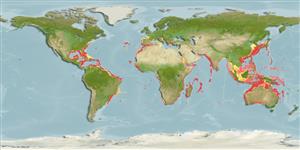
Indo-West Pacific: patchily distributed in most warm-temperate and tropical seas.
Length at first maturity / Size / Weight / Age
Maturity: Lm ?, range 142 - ? cm
Max length : 180 cm TL male/unsexed; (Ref. 125614); 142.0 cm TL (female)
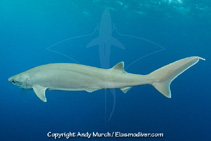
Vertebrae: 155. This slender-bodied shark is readily distinguished from its larger congener (H. griseus) by having a narrower head, relatively larger eyes, 5 large lower comb-shaped anterolateral teeth, a long slender dorsal-caudal space, with distance from the dorsal origin to the upper caudal origin being at least twice the length of the dorsal fin base; with the upper and lower caudal postventral margins forming a strong arch. In life, Color of dorsum a uniform pale brown without a light line extending along the lateral body trunk, the trailing fin edges are white in some specimens and the ventral surface is lighter (Ref. 94780).
Found on continental and island shelves and slopes, occasionally near surface or inshore from 0 to 700 m depth. Feeds on small to medium-sized bony fishes and occassionally on crustaceans. Viviparous, with 13-26 young in a litter (Ref. 125614). Size at birth measures to about 40-43 cm TL (Ref. 94780). It is taken as bycatch within its range, but is not commercially important (Ref. 125614). Utilized for its fins, meat and liver oil but of little value due to its relatively small size (Ref. 58048).
Life cycle and mating behavior
Maturity | Reproduction | Spawning | Eggs | Fecundity | Larvae
Viviparous, with number of young 13 in one litter. Length at birth about 43 cm (Ref. 125614). Distinct pairing with embrace (Ref. 205).
Ebert, D.A., W.T. White and H.-H. Ho, 2013. Redescription of Hexanchus nakamurai Teng 1962, (Chondrichthyes: Hexanchiformes: Hexanchidae), with designation of a neotype. Zootaxa 3752(1):020-034. (Ref. 94780)
IUCN Red List Status (Ref. 130435)
Human uses
Fisheries: subsistence fisheries
More information
ReferencesAquacultureAquaculture profileStrainsGeneticsElectrophoresesHeritabilityDiseasesProcessingNutrientsMass conversion
Tools
Special reports
Download XML
Internet sources
Estimates based on models
Preferred temperature (Ref.
123201): 8.1 - 23.9, mean 14.4 °C (based on 1233 cells).
Phylogenetic diversity index (Ref.
82804): PD
50 = 0.8281 [Uniqueness, from 0.5 = low to 2.0 = high].
Bayesian length-weight: a=0.00240 (0.00102 - 0.00563), b=3.14 (2.93 - 3.35), in cm total length, based on LWR estimates for this (Sub)family-body shape (Ref.
93245).
Trophic level (Ref.
69278): 4.2 ±0.7 se; based on diet studies.
Resilience (Ref.
120179): Very Low, minimum population doubling time more than 14 years (Fec = 13).
Fishing Vulnerability (Ref.
59153): Very high vulnerability (90 of 100).