Teleostei (teleosts) >
Eupercaria/misc (Various families in series Eupercaria) >
Monodactylidae (Moonyfishes or fingerfishes)
Etymology: Monodactylus: Greek, monos = one + Greek, daktylos = finger (Ref. 45335).
More on author: Linnaeus.
Environment: milieu / climate zone / depth range / distribution range
Ecology
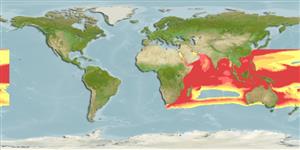
Marine; freshwater; brackish; pelagic-neritic; depth range 0 - 12 m (Ref. 86942). Tropical; 24°C - 28°C (Ref. 1672); 31°N - 42°S, 19°E - 169°W
Indo-West Pacific: Red Sea and east coast of Africa south to the Breë River (Ref. 7293, 52193); also the Persian Gulf (Ref. 96822) to Samoa, north to the Yaeyamas, south to New Caledonia and Australia (Ref. 4959). Known from the freshwater tidal zone of the Mekong delta (Ref. 12693).
Length at first maturity / Size / Weight / Age
Maturity: Lm 13.0 range ? - ? cm
Max length : 27.0 cm SL male/unsexed; (Ref. 44894); common length : 12.0 cm TL male/unsexed; (Ref. 5450)
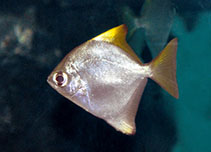
Found in bays, mangrove estuaries, tidal creeks, and lower reaches of freshwater streams (Ref. 2847, 44894, 48636); occasionally in silty coastal reefs (Ref. 9710). It feeds on plankton and detritus (Ref. 5213, 44894). Commonly seen in large schools (Ref. 44894, 52193); small juveniles either solitary or in small aggregations (Ref. 48635). Usually only juveniles enter freshwater (Ref. 52193). Highly territorial (Ref. 9710). Caught with throw nets (Ref. 30573).
Life cycle and mating behavior
Maturity | Reproduction | Spawning | Eggs | Fecundity | Larvae
Heemstra, P.C., 1984. Monodactylidae. In W. Fischer and G. Bianchi (eds.) FAO species identification sheets for fishery purposes. Western Indian Ocean (Fishing Area 51). Vol. 3. FAO, Rome. [pag. var.]. (Ref. 7293)
IUCN Red List Status (Ref. 130435)
Threat to humans
Harmless
Human uses
Fisheries: minor commercial; aquarium: commercial
Tools
Special reports
Download XML
Internet sources
Estimates based on models
Preferred temperature (Ref.
123201): 22.9 - 28.8, mean 27.6 °C (based on 638 cells).
Phylogenetic diversity index (Ref.
82804): PD
50 = 0.5781 [Uniqueness, from 0.5 = low to 2.0 = high].
Bayesian length-weight: a=0.02951 (0.01733 - 0.05027), b=2.98 (2.83 - 3.13), in cm total length, based on LWR estimates for this species & (Sub)family-body (Ref.
93245).
Trophic level (Ref.
69278): 3.0 ±0.33 se; based on food items.
Fishing Vulnerability (Ref.
59153): Low vulnerability (23 of 100).
Nutrients (Ref.
124155): Calcium = 187 [94, 330] mg/100g; Iron = 1.44 [0.85, 2.58] mg/100g; Protein = 18.3 [17.2, 19.3] %; Omega3 = 0.172 [0.089, 0.312] g/100g; Selenium = 32.5 [15.1, 68.3] μg/100g; VitaminA = 14.6 [4.7, 46.6] μg/100g; Zinc = 1.89 [1.28, 2.77] mg/100g (wet weight);