Environment: milieu / climate zone / depth range / distribution range
Ecology
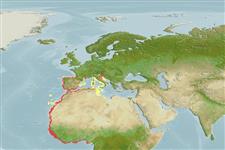
Marine; demersal; depth range 10 - 50 m (Ref. 2683). Subtropical; 45°N - 4°N, 18°W - 17°E
Eastern Atlantic: southern Bay of Biscay to Ghana, including the western Mediterranean. Reported from the Gambia River (Ref. 28587).
Size / Weight / Age
Maturity: Lm ? range ? - ? cm
Max length : 50.0 cm TL male/unsexed; (Ref. 26999); common length : 35.0 cm TL male/unsexed; (Ref. 3397)
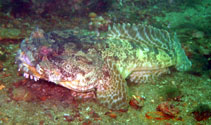
Sedentary species which occurs on soft sand or mud, often partly buried or concealed in rock crevices, solitary in shallow water. Feeds on crustaceans, mollusks and small fishes (Ref. 7405). The female lays eggs which are large enough and which are turned over to the males who guard them (Ref. 5377). A species that is not venomous (Dr. Andread Kunznmann, Leibniz Centre for Tropical Marine Research (ZMT), pers. communication 10/2021).
Life cycle and mating behavior
Maturity | Reproduction | Spawning | Eggs | Fecundity | Larvae
Bauchot, M.-L., 1987. Poissons osseux. p. 891-1421. In W. Fischer, M.L. Bauchot and M. Schneider (eds.) Fiches FAO d'identification pour les besoins de la pêche. (rev. 1). Méditerranée et mer Noire. Zone de pêche 37. Vol. II. Commission des Communautés Européennes and FAO, Rome. (Ref. 3397)
IUCN Red List Status (Ref. 130435)
Threat to humans
Harmless
Human uses
Fisheries: minor commercial
More information
Common namesSynonymsMetabolismPredatorsEcotoxicologyReproductionMaturitySpawningSpawning aggregationFecundityEggsEgg development
ReferencesAquacultureAquaculture profileStrainsGeneticsElectrophoresesHeritabilityDiseasesProcessingNutrientsMass conversion
Tools
Special reports
Download XML
Internet sources
Estimates based on models
Preferred temperature (Ref.
123201): 15.5 - 27.5, mean 19.8 °C (based on 74 cells).
Phylogenetic diversity index (Ref.
82804): PD
50 = 1.0000 [Uniqueness, from 0.5 = low to 2.0 = high].
Bayesian length-weight: a=0.01175 (0.00470 - 0.02937), b=3.04 (2.83 - 3.25), in cm total length, based on LWR estimates for this (Sub)family-body shape (Ref.
93245).
Trophic level (Ref.
69278): 4.0 ±0.64 se; based on food items.
Resilience (Ref.
120179): Low, minimum population doubling time 4.5 - 14 years (Preliminary K or Fecundity.).
Fishing Vulnerability (Ref.
59153): Moderate vulnerability (40 of 100).
Climate Vulnerability (Ref.
125649): Moderate vulnerability (39 of 100).
Nutrients (Ref.
124155): Calcium = 65.9 [35.0, 131.4] mg/100g; Iron = 0.966 [0.578, 1.659] mg/100g; Protein = 18.6 [17.6, 19.6] %; Omega3 = 0.399 [0.239, 0.671] g/100g; Selenium = 23.4 [12.6, 50.5] μg/100g; VitaminA = 15.9 [5.2, 48.4] μg/100g; Zinc = 0.709 [0.531, 0.999] mg/100g (wet weight);