Teleostei (teleosts) >
Acanthuriformes (Surgeonfishes) >
Siganidae (Rabbitfishes)
Etymology: Siganus: Latin, siganus = a fish, rabbit fish; by the similarity of the nose (Ref. 45335).
Environment: milieu / climate zone / depth range / distribution range
Ecology
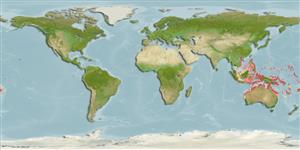
Marine; reef-associated; depth range 0 - 15 m (Ref. 90102). Tropical; 20°N - 29°S, 102°E - 174°W
Western Pacific: scarcely entering the Indo-Malayan area (except eastern Indonesia), north to Palau and Kosrae, south to northwestern Australia and Tonga (Ref. 43045). Replaced by closely related Siganus virgatus from Sulawesi and the Philippines to south India (Ref. 37816).
Size / Weight / Age
Maturity: Lm ? range ? - ? cm
Max length : 25.0 cm SL male/unsexed; (Ref. 48637); common length : 20.0 cm TL male/unsexed; (Ref. 9813)
Dorsal
spines
(total): 13;
Dorsal
soft rays
(total): 10;
Anal
spines: 7;
Anal
soft rays: 9;
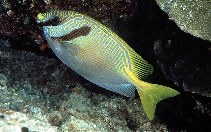
Vertebrae: 13. Body blue above, silvery white below; from nape through eye to chin a seal brown band, another from base of 4th-5th dorsal spines to just below of pectoral fin. Spines stout, pungent and venomous. Preopercular 97°-110°. Strong scales cover cheeks. Midline of thorax fully scaled; sometimes a few scales absent from pelvic ridges.
Inhabits coral-rich areas of lagoons and seaward reefs. Juveniles form schools. Pairs form at 7 cm; but these pairs continue to form loose schools, sometimes with juvenile scarids, to feed in areas being flooded by the tide. At 20 cm, isolated pairs in deep water lagoons or on drop-offs at reef-edges feed on benthic seaweeds (Ref. 9813, 48637). Anterolateral glandular grooves with venom gland (Ref. 57406). Very closely related to the blue-spotted S. virgatus (Valenciennes) and apparently hybridizes at times with it in the Indo-Malayan region (Ref. 2334). Minimum depth reported taken from Ref. 128797.
Life cycle and mating behavior
Maturity | Reproduction | Spawning | Eggs | Fecundity | Larvae
Woodland, D.J., 1990. Revision of the fish family Siganidae with descriptions of two new species and comments on distribution and biology. Indo-Pac. Fish. (19):136 p. (Ref. 1419)
IUCN Red List Status (Ref. 130435)
Human uses
Fisheries: minor commercial
More information
ReferencesAquacultureAquaculture profileStrainsGeneticsElectrophoresesHeritabilityDiseasesProcessingNutrientsMass conversion
Tools
Special reports
Download XML
Internet sources
Estimates based on models
Preferred temperature (Ref.
123201): 25.5 - 29.3, mean 28.6 °C (based on 1956 cells).
Phylogenetic diversity index (Ref.
82804): PD
50 = 0.5000 [Uniqueness, from 0.5 = low to 2.0 = high].
Bayesian length-weight: a=0.01349 (0.00792 - 0.02298), b=3.11 (2.96 - 3.26), in cm total length, based on LWR estimates for this species & Genus-body shape (Ref.
93245).
Trophic level (Ref.
69278): 2.0 ±0.00 se; based on food items.
Resilience (Ref.
120179): High, minimum population doubling time less than 15 months (Preliminary K or Fecundity.).
Fishing Vulnerability (Ref.
59153): Low vulnerability (21 of 100).
Nutrients (Ref.
124155): Calcium = 46.6 [23.3, 110.7] mg/100g; Iron = 0.739 [0.348, 1.700] mg/100g; Protein = 18.5 [17.0, 20.0] %; Omega3 = 0.0989 [, ] g/100g; Selenium = 18.4 [7.3, 46.3] μg/100g; VitaminA = 35.5 [8.3, 144.5] μg/100g; Zinc = 1.52 [0.59, 3.25] mg/100g (wet weight);