Elasmobranchii (sharks and rays) >
Rajiformes (Skates and rays) >
Rajidae (Skates)
Etymology: Raja: Latin, raja, -ae = a sting ray (Raja sp.) (Ref. 45335).
Environment: milieu / climate zone / depth range / distribution range
Ecology
Marine; demersal; depth range 10 - 380 m (Ref. 6808). Temperate; 60°N - 22°N, 18°W - 24°E
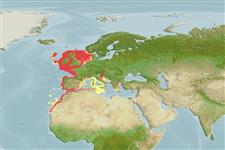
Eastern Atlantic: Shetland Islands to Morocco, Rio de Oro (Western Sahara), and Madeira.
Length at first maturity / Size / Weight / Age
Maturity: Lm 90.2, range 60 - ? cm
Max length : 120 cm TL male/unsexed; (Ref. 41333); 125.0 cm TL (female); max. published weight: 14.3 kg (Ref. 40637)
Dorsal
spines
(total): 0;
Anal
spines: 0;
Anal
soft rays: 0. Upper surface wholly prickly, except in juveniles; underside only prickly along front margins of disc; orbital thorns separate; a regular median row of 40-45 thorns in juveniles and adult females, interrupted on back in males; 60-90 tooth rows; upper surface ochre, with numerous small dark spots to margins of disc, underside white (Ref. 3167).
Found on sand and sand-rock bottoms (Ref. 6808). Feed on all kinds of benthic animals (Ref. 3167). Oviparous. Distinct pairing with embrace. Young may tend to follow large objects, such as their mother (Ref. 205). Eggs are oblong capsules with stiff pointed horns at the corners deposited in sandy or muddy flats (Ref. 205). Egg capsules are 10.0-14.3 cm long and 5.8-9.0 cm wide (Ref. 41250). About 40-90 eggs are laid per individual every year (Ref. 41250).
Oviparous, paired eggs are laid. Embryos feed solely on yolk (Ref. 50449). Spawning mainly from February to August with at least 30 egg-cases laid (Ref. 3167). Distinct pairing with embrace. Young may tend to follow large objects, such as their mother (Ref. 205).
McEachran, J.D. and K.A. Dunn, 1998. Phylogenetic analysis of skates, a morphologically conservative clade of elasmobranchs (Chondrichthyes: Rajidae). Copeia 1998(2):271-290. (Ref. 27314)
IUCN Red List Status (Ref. 130435)
Threat to humans
Harmless
Human uses
Fisheries: minor commercial; gamefish: yes
More information
ReferencesAquacultureAquaculture profileStrainsGeneticsElectrophoresesHeritabilityDiseasesProcessingNutrientsMass conversion
Tools
Special reports
Download XML
Internet sources
Estimates based on models
Preferred temperature (Ref.
123201): 7.1 - 16.2, mean 10.3 °C (based on 462 cells).
Phylogenetic diversity index (Ref.
82804): PD
50 = 0.5000 [Uniqueness, from 0.5 = low to 2.0 = high].
Bayesian length-weight: a=0.00224 (0.00144 - 0.00349), b=3.27 (3.15 - 3.39), in cm total length, based on LWR estimates for this species & Genus-body shape (Ref.
93245).
Trophic level (Ref.
69278): 3.8 ±0.61 se; based on food items.
Resilience (Ref.
120179): Low, minimum population doubling time 4.5 - 14 years (K=0.12-0.19; tmax=15; Fec=40).
Prior r = 0.20, 95% CL = 0.11 - 0.36, Based on 1 stock assessment.
Fishing Vulnerability (Ref.
59153): High to very high vulnerability (65 of 100).
Climate Vulnerability (Ref.
125649): High vulnerability (61 of 100).
Nutrients (Ref.
124155): Calcium = 4.69 [0.73, 84.95] mg/100g; Iron = 0.26 [0.02, 2.99] mg/100g; Protein = 16.7 [13.9, 19.0] %; Omega3 = 0.869 [0.349, 2.113] g/100g; Selenium = 14.8 [3.0, 71.4] μg/100g; VitaminA = 7.7 [0.6, 90.3] μg/100g; Zinc = 0.31 [0.02, 3.43] mg/100g (wet weight);