Teleostei (teleosts) >
Gobiiformes (Gobies) >
Gobiidae (Gobies) > Gobiinae
Etymology: Stonogobiops: Greek, stonos, -ou = groan + Latin, gobius = gudgeon + Greek, ops = appearance (Ref. 45335).
Environment: milieu / climate zone / depth range / distribution range
Ecology
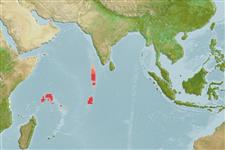
Marine; reef-associated; depth range 15 - 37 m (Ref. 9360), usually 20 - ? m (Ref. 30404). Tropical; 10°N - 10°S
Western Indian Ocean: Seychelles, Maldives.
Size / Weight / Age
Maturity: Lm ? range ? - ? cm
Max length : 7.0 cm TL male/unsexed; (Ref. 30404)
Dorsal
spines
(total): 7;
Dorsal
soft rays
(total): 10;
Anal
spines: 1;
Anal
soft rays: 9;
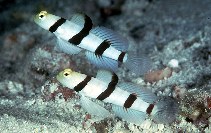
Vertebrae: 26. Eyes and mouth large. Head yellow anteriorly and dorsally, white posteriorly; broad, diagonal bar from ventroposterior part of head to nape; 5 head pores. White interspaces on body bisected by orange-red line. First dark bar of body continued into the first, round dorsal fin; 2nd dorsal, anal and caudal fins pale whitish. Pectoral fins pointed. No scales on thorax and pectoral base. Angle of jaws 35 degrees. Palatines with tooth-like processes. Longitudinal scale series 84-94, transverse 26-32. Naked median predorsal region.
Inhabits open sand and rubble zones adjacent to reefs (Ref. 30404). Occurs in pairs and hovers above the burrow entrance. Lives symbiotically with Alpheus randalli (Ref. 9360).
Life cycle and mating behavior
Maturity | Reproduction | Spawning | Eggs | Fecundity | Larvae
Hoese, D.F. and J.E. Randall, 1982. Revision of the Indo-Pacific gobiid fish genus Stonogobiops. Indo-Pac. Fish. (1):18 p. (Ref. 397)
IUCN Red List Status (Ref. 130435)
Threat to humans
Harmless
Human uses
More information
Common namesSynonymsMetabolismPredatorsEcotoxicologyReproductionMaturitySpawningSpawning aggregationFecundityEggsEgg development
ReferencesAquacultureAquaculture profileStrainsGeneticsElectrophoresesHeritabilityDiseasesProcessingNutrientsMass conversion
Tools
Special reports
Download XML
Internet sources
Estimates based on models
Preferred temperature (Ref.
123201): 20 - 28.2, mean 27.6 °C (based on 8 cells).
Phylogenetic diversity index (Ref.
82804): PD
50 = 0.5078 [Uniqueness, from 0.5 = low to 2.0 = high].
Bayesian length-weight: a=0.01023 (0.00477 - 0.02194), b=3.02 (2.84 - 3.20), in cm total length, based on LWR estimates for this (Sub)family-body shape (Ref.
93245).
Trophic level (Ref.
69278): 3.2 ±0.3 se; based on size and trophs of closest relatives
Resilience (Ref.
120179): High, minimum population doubling time less than 15 months (Preliminary K or Fecundity.).
Fishing Vulnerability (Ref.
59153): Low vulnerability (10 of 100).