Manta birostris   (Walbaum, 1792)

Giant manta
Catalog of Fishes (gen., sp.) | ITIS | CoL
Classification
Elasmobranchii | Rajiformes | Myliobatidae | Mobulinae
Synonyms
Common names
Advertisement

You can sponsor this page
Upload your photos and videos
| All pictures | Google image | Stamps |
Image of Manta birostris (Giant manta)
Picture by Yin, Robert
Videos of Manta birostris Play video    
Add your observation in Fish Watcher
| Native range | All suitable habitat | PointMap | Year 2050 |
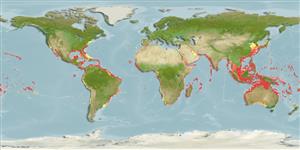
Aquamaps of Manta birostris This map was computer-generated and has not yet been reviewed.
AquaMaps     Data sources: GBIF OBIS
Main reference
Size / Weight / Age
Max length : 910 cm WD male/unsexed; (Ref. 58048); common length : 450 cm WD male/unsexed; (Ref. 3176); max. published weight: 3,000.0 kg (Ref. 5377); max. reported age: 20 years (Ref. 31742)
Environment
Reef-associated; oceanodromous (Ref. 51243); marine; depth range 0 - 120 m (Ref. 58302), usually 0 - ? m (Ref. 55255)
Climate / Range
Subtropical; 31°N - 35°S, 180°W - 180°E (Ref. 55255)
Distribution
Circumtropical. Western Atlantic: Bermuda and South Carolina, USA and Brazil to Uruguay (Ref. 58839), occasionally farther north (Ref. 26938). Northwest Atlantic: Canada (Ref. 5951).
Countries | FAO areas | Ecosystems | Occurrences | Introductions
Short description
A giant ray having an extremely broad head with long head fins, and a terminal mouth; upper surface of disc covered with denticles, and tail usually without a spine (Ref. 5578). Blackish above, sometimes with white shoulder patches; white below, with grey edging on disc (Ref. 5578). Tail whiplike but short (Ref. 7251).
Biology
    Glossary (e.g. epibenthic)
Mainly in near-shore waters, near coral and rocky reefs; sometimes found over deep water (Ref. 12951). Penetrates shallow muddy bays and the intertidal and occurs off river mouths (Ref. 9911). Pelagic (Ref. 58302). Occurs singly or in loose aggregations (Ref. 12951). Mainly plankton feeders, but may feed on small and moderate-sized fishes as well (Ref. 9911). Leaps out the water mainly in spring and autumn, possibly as part of mating behavior (Ref. 31742). Easily approached (Ref. 9911). Ovoviviparous (Ref. 6902). Commonly caught by tuna gillnet and harpoon fisheries. Utilized for its gill filter plates (very high value), meat, cartilage and skin (Ref.58048). Liver yields oil and skin used as abrasive (Ref. 6902). World's largest ray (Ref. 37816).
IUCN Red List Status (Ref. 57073)
Threat to humans
  Harmless (Ref. 9911)
Human uses
Fisheries: minor commercial
More information
Countries
FAO areas
Ecosystems
Occurrences
Introductions
Ecology
Diet
Food items
Food consumption
Ration
Common names
Synonyms
Metabolism
Predators
Ecotoxicology
Reproduction
Maturity
Spawning
Eggs
Egg development
Age/Size
Growth
Length-weight
Length-length
Length-frequencies
Morphometrics
Morphology
Larvae
Larval dynamics
Recruitment
Other references
Biblio
Aquaculture
Aquaculture profile
Strains
Genetics
Allele frequencies
Heritability
Diseases
Processing
Collaborators
Pictures
Stamps
Sounds
Ciguatera
Speed
Swim. type
Gill area
Otoliths
Brains
Vision
Tools
Special reports
Download XML
Internet sources
Estimation of some characteristics with mathematical models
Resilience (Ref. 69278)
Very Low, minimum population doubling time more than 14 years (tm=6; tmax=20; Fec=2)
Vulnerability (Ref. 59153)
Price category (Ref. 80766)
Very high vulnerability (79 of 100)

Entered by Luna, Susan M.
Modified by Wiethüchter, Anita


FishBase mirror site : US - CGNET
Page last modified by : elaxamana, 15 July 2009

Custom Search


Total processing time for the page : 0.4417 seconds