Environment: milieu / climate zone / depth range / distribution range
Ecology
Freshwater; brackish; pelagic. Tropical; 1°N - 2°S
South America: Amazon drainage (from perhaps mouth of Rio Branco at Goiaçu, Rio Solimões, Rio Juruá and as far as the Río Ucayali in Peru). (There are possibly two species, judging from specimens in the Museu de Zoológia, Sao Paulo).
Size / Weight / Age
Maturity: Lm ? range ? - ? cm
Max length : 14.5 cm SL male/unsexed; (Ref. 50591); common length : 8.5 cm SL male/unsexed; (Ref. 188)
Dorsal
spines
(total): 0;
Anal
spines: 0;
Anal
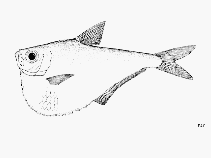
soft rays: 45 - 54. Belly profile strongly convex (almost circular from throat to anus), 30 to 33 scutes. Lower jaw projecting, mouth directed almost vertically upward; no toothed hypo-maxillary bone between hind end of pre-maxilla and lower bulge of maxilla blade; eye large. Pectoral fins high on body; anal fin origin behind dorsal fin base; upper caudal fin lobe ending in a filament in larger fishes (Ref. 188).
Occurs in rivers but perhaps entering slightly saline waters near the mouth of Amazon (but this part of its range is not well documented). Compared with the `flying' characoid fishes (e.g. Thoracocharax), the vertically aligned scute arms in Pristigaster and the rather small pectoral muscles show that flight by vibration of the pectoral fins is almost certainly impossible. This species having been caught along with Thoracocharax raises the question of mimicry.
Life cycle and mating behavior
Maturity | Reproduction | Spawning | Eggs | Fecundity | Larvae
Whitehead, P.J.P., 1985. FAO Species Catalogue. Vol. 7. Clupeoid fishes of the world (suborder Clupeoidei). An annotated and illustrated catalogue of the herrings, sardines, pilchards, sprats, shads, anchovies and wolf-herrings. FAO Fish. Synop. 125(7/1):1-303. Rome: FAO. (Ref. 188)
IUCN Red List Status (Ref. 130435)
Threat to humans
Harmless
Human uses
Fisheries: of no interest
More information
Common namesSynonymsMetabolismPredatorsEcotoxicologyReproductionMaturitySpawningSpawning aggregationFecundityEggsEgg development
ReferencesAquacultureAquaculture profileStrainsGeneticsElectrophoresesHeritabilityDiseasesProcessingNutrientsMass conversion
Tools
Special reports
Download XML
Internet sources
Estimates based on models
Phylogenetic diversity index (Ref.
82804): PD
50 = 0.7500 [Uniqueness, from 0.5 = low to 2.0 = high].
Bayesian length-weight: a=0.01585 (0.00612 - 0.04107), b=3.05 (2.82 - 3.28), in cm total length, based on LWR estimates for this (Sub)family-body shape (Ref.
93245).
Trophic level (Ref.
69278): 3.4 ±0.5 se; based on size and trophs of closest relatives
Resilience (Ref.
120179): High, minimum population doubling time less than 15 months (Preliminary K or Fecundity.).
Fishing Vulnerability (Ref.
59153): Low vulnerability (10 of 100).