Teleostei (teleosts) >
Clupeiformes (Herrings) >
Dorosomatidae (Gizzard shads and sardinellas)
Etymology: Sardinella: Latin and Greek, sarda = sardine; name related to the island of Sardinia; diminutive (Ref. 45335).
More on author: Bleeker.
Environment: milieu / climate zone / depth range / distribution range
Ecology
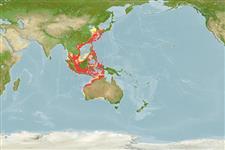
Marine; pelagic-neritic; oceanodromous (Ref. 51243); depth range 15 - 100 m (Ref. 12260). Tropical; 38°N - 33°S, 97°E - 134°E (Ref. 54869)
Eastern Indian Ocean: Phuket, Thailand; southern coasts of East Java and Bali; and Western Australia. Western Pacific: Java Sea, Philippines, Hong Kong, Taiwan Island, southern Japan. Can not be distinguished as yet on morphological grounds from Sardinella aurita which occurs in the Atlantic Ocean.
Length at first maturity / Size / Weight / Age
Maturity: Lm 14.3, range 14 - 15 cm
Max length : 23.0 cm SL male/unsexed; (Ref. 188); common length : 20.0 cm SL male/unsexed; (Ref. 188)
Dorsal
spines
(total): 0;
Dorsal
soft rays
(total): 13-21;
Anal
spines: 0;
Anal
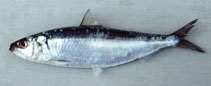
soft rays: 12 - 23. A faint golden spot behind gill opening, followed by a faint golden mid-lateral line; a distinct black spot at hind border of gill cover (absence of pigment). Body elongate, sub-cylindrical. Distinguished from all other clupeids in the eastern Indian Ocean and western Pacific by its pelvic fin ray count of i 8; from S. longiceps by its shorter head length and fewer lower gill rakers.
Adults form large schools in coastal waters, particularly in the Bali Strait upwelling. Found in sheltered bays and lagoons (Ref. 48635). They feed on phytoplankton and zooplankton, chiefly copepods. Time series analysis (Ref. 9586) suggests that recruitment fluctuations are related to ENSO events, as defined in Ref. 9577, 9578 and 9580.
Spawning tends to take place in inshore waters where salinity is low (Ref. 6863) at the beginning of the rainy season. Spawning aggregations may be formed, also including Amblygaster sirm, A. leogaster and Clupea fimbriata.
Whitehead, P.J.P., 1985. FAO Species Catalogue. Vol. 7. Clupeoid fishes of the world (suborder Clupeoidei). An annotated and illustrated catalogue of the herrings, sardines, pilchards, sprats, shads, anchovies and wolf-herrings. FAO Fish. Synop. 125(7/1):1-303. Rome: FAO. (Ref. 188)
IUCN Red List Status (Ref. 130435)
Threat to humans
Harmless
Human uses
Fisheries: highly commercial
More information
ReferencesAquacultureAquaculture profileStrainsGeneticsElectrophoresesHeritabilityDiseasesProcessingNutrientsMass conversion
Tools
Special reports
Download XML
Internet sources
Estimates based on models
Preferred temperature (Ref.
123201): 22.8 - 28.6, mean 27.8 °C (based on 500 cells).
Phylogenetic diversity index (Ref.
82804): PD
50 = 0.5000 [Uniqueness, from 0.5 = low to 2.0 = high].
Bayesian length-weight: a=0.00741 (0.00477 - 0.01152), b=3.09 (2.97 - 3.21), in cm total length, based on LWR estimates for this species & Genus-body shape (Ref.
93245).
Trophic level (Ref.
69278): 2.5 ±0.00 se; based on food items.
Generation time: 1.1 (1.0 - 1.3) years. Estimated as median ln(3)/K based on 18
growth studies.
Resilience (Ref.
120179): High, minimum population doubling time less than 15 months (K=0.8-1.3; tmax=4.5).
Prior r = 1.19, 95% CL = 0.79 - 1.79, Based on 6 stock assessments.
Fishing Vulnerability (Ref.
59153): Low vulnerability (17 of 100).
Climate Vulnerability (Ref.
125649): Moderate to high vulnerability (46 of 100).
Nutrients (Ref.
124155): Calcium = 257 [134, 389] mg/100g; Iron = 1.99 [1.18, 3.52] mg/100g; Protein = 20.3 [19.3, 21.3] %; Omega3 = 0.286 [0.140, 0.547] g/100g; Selenium = 114 [61, 228] μg/100g; VitaminA = 22.2 [7.0, 65.8] μg/100g; Zinc = 1.3 [0.9, 1.8] mg/100g (wet weight);