 … 6.1)
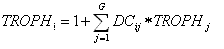
 Fish populations do not live by themselves. Rather, they are embedded in ecosystems where they perform their roles as consumers and prey of other organisms, including larger fishes. The position of an organism in the food web is depicted by its trophic level, which is estimated as follows:
… 6.1)
where TROHPi is the trophic level of species (i), TROPHj is the trophic level of prey (j), DCij is the contribution of prey (j) in the diet of species (i) and G is the total number of prey.
Trophic levels in aquatic environments generally range from 2, for herbivores and detritivores, to 5.5, for specialised predators of marine mammals, such as the polar bear, Ursus maritimus and the killer whale, Orcinus orca. The trophic levels of fishes generally range from 2 (e.g., the detritus feeding blue-barred parrotfish) to 4.7 (e.g., the piscivorous striped marlin), whereas those of marine mammals range from 3 (e.g., the predominantly seagrass feeding dugong) to 5.5 (e.g., the carnivorous killer whale), those of cephalopods from 3.2 (e.g., the planktivorous Patagonian squid) to 4.5 (e.g., the piscivorous greater hooked squid), and of marine birds from 2.6 (e.g., the gastropod feeding Mediterranean gull) to 4.9 (e.g., the petrel preying brown skua; see Pauly et al. 2000; Froese et al. 2004; Karpouzi 2005).
It is important to compare the consumption patterns of humans in the terrestrial and aquatic realms in terms of trophic levels. The terrestrial animals consumed by humans have usually trophic level 2 (e.g., cows, pigs, chickens, lamb). In contrast, humans have a strong preference for large-sized fishes such as flatfishes, hakes, cods, tunas, swordfishs, all of which have trophic levels higher than 4. This is the equivalent of consuming the terrestrial predators of lions and tigers (i.e., dragons?).
Trophic level has gained wide acceptance as an ecological indicator for ecosystem management. One measure, the marine trophic index, has been selected by the Conference of the Parties to the Convention of Biological Diversity as 1 of 8 biodiversity indicators (see Pauly & Watson 2005). Its strength as an ecological indicator lies in its efficiency in capturing/expressing fishing-induced effects at the community or ecosystem level, either directly: (a) for identifying the 'fishing down the marine food webs' process (Pauly et al. 1998; see section 6.6, Effects of fishing on ecosystems) and (b) for estimating the trophic impact of different fishing gears (see section 6.3, Trophic signatures), or indirectly (c) for estimating other indicators (e.g., Primary Production Required to support fisheries, Pauly and Christensen 1995; 'Fishery in Balance' index, Pauly et al. 2000).
• Find published studies on the diet composition of three different species of fish: one mainly herbivore; one omnivore, and one typical carnivore. Compute their trophic levels using the classification of diet items and trophic levels in Table 3.5. [Hint: see Boxes 25-26 of the FishBase book.]
The role of fishes within ecosystems is largely a function of their size: small fish are more likely to have a vast array of predators than very large ones. On the other hand, various anatomical and physiological adaptations may lead to dietary specialization, enabling different fish species to function as herbivores, with a trophic level of 2.0, or carnivores, with trophic levels typically ranging from 3.0 to about 4.5.
Moreover, trophic levels change during ontogeny of fishes. Larvae, which usually feed on herbivorous zooplankton (TL=2.0) consequently have a trophic level of about 3.0. Subsequent growth enables the juveniles to consume larger, predatory zooplankton and small fishes or benthic invertebrates; this leads to an increase in trophic level, often culminating in values around 4.5 in purely piscivorous, large fishes.
• Find from FishBase 10 small-, 10 medium- and 10 large-sized species with information on trophic level. Plot trophic level vs. Lmax.
• Assemble diet composition studies for different sizes of the same species of fish, preferably in the same population, and show trophic level changes with ontogeny.
The plot of the number of species in an ecosystem per trophic level class is called trophic signature (Froese et al. 2005). Trophic signatures are useful for comparing different ecosystems in terms of the embedded functional groups. Thus, the analysis of different ecosystems shows that although the numbers of species present in these ecosystems differ, most ecosystems are dominated by omnivorous species (trophic level class 3-3.5) (Froese et al. 2005). Trophic signatures can also be estimated for fishing gears (Stergiou et al. 2006) in order to identify the effect of different gears in terms of trophic classes impacted.
• Select one tropical, one temperate and one arctic ecosystem. Extract all the fish species and their trophic levels. [Hint: use the Information by Ecosystem routine.] Construct their trophic signatures. Compare them and discuss the results.
For formal descriptions of the role of fish in ecosystems and their responses to changes in fishing, and other changes, see the Ecopath with Ecosim modeling tool at www.ecopath.org. There is a strong link between Ecopath and FishBase, i.e., the trophic ecology suite of tables enables FishBase to construct trophic pyramids, species ecology matrices and list parameters useful in constructing ecosystem models for a given area or ecosystem.
• Identify a marine ecosystem that interests you and draw a food web incorporating the diet information on major fish and invertebrates in that ecosystem. [Hint: use the Information by Ecosystem routine.]
The mass removal of immature individuals has detrimental effects for the stocks, the communities, the ecosystems and their supported fisheries (e.g., Froese 2004). The removal of immature fish contributes to the decline of these stocks bringing about growth overfishing (Pauly 1979). Compare this to the idea of 'eating babies' before they even grow to become adults and having their own babies, i.e., 'forgone' production (Jensen et al. 1988). Catch consisting of immature, small-sized individuals is usually valued at relative low prices, i.e., fish feed. Thus, growth overfishing has important economic repercussions because, small fishes, if allowed to grow and be caught later at a much larger size, represent production valued at much higher prices (Jennings et al. 1999).
Table 6.1. Minimum Landing Sizes (MLS) for 13 fish species in Greek waters (from Stergiou et al., in press).
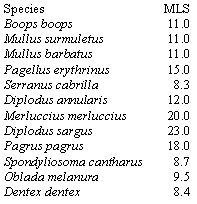
One technical managerial measure against growth overfishing is the establishment of Minimum Landing Sizes (MLS) for the main commercial stocks, i.e., landing of individuals with sizes smaller than MLS is not allowed. In order for such MLS to be ecologically meaningful they must be harmonized with the life-history of the species (i.e., being at least equal or slightly larger than L m: all fish should be allowed to spawn at least once). This is especially crucial for large-sized, high trophic level species, e.g., sharks, tunas, trevallies, jacks, whose stocks are prone to overfishing.
• Find one Lm value for the Mediterranean Sea for each species in Table 6.1. If more than one value is available per species, estimate the mean and its s.e. Compare the Lm (mean+/-s.e., if available) with the minimum landing size (MLS) of the species. Discuss the results. [Hint: Lm can be estimated using equation 4.1 (section 4.1 on the Reproductive load concept).]
Froese (2004) suggested that the following three, simple to estimate, indicators can be used for the management of fisheries resources in order to rebuild and maintain healthy spawning stocks.
Indicator 1: 'let them spawn'. This refers to the percentage (i.e., 100%) of mature specimens in the catch and aims at letting fish spawn at least once before they are caught.
Indicator 2: 'let them grow'. This refers to the percentage of fish caught at optimum length, Lopt, i.e., the length at which the number of fish in a given unfished year-class multiplied with their mean individual weight is maximum and where the maximum yield and revenue can be obtained. Lopt is typically a bit larger than Lm and can be estimated from growth and mortality parameters (Beverton 1992):
Lopt=L∞·(3/(3+M/K)) … 6.2)
It can also be estimate from the empirical equation of Froese and Binohlan (2000), which was based on data from FishBase. The aim here is to catch all fish (100%) within, e.g., Lopt±10%.
Indicator 3: 'let the megaspawners live'. This refers to the percentage of old, large-sized fish in the catch, i.e., fish of a size > Lopt+10%. The aim here is to implement a fishing strategy for which no (0%) mega-spawners are caught. If such a strategy does not exist, and thus the catch reflects the age and size structure of the stock, values of 30–40% megaspawners in the stock represent a healthy age structure, whereas values of <20% should be alarming.
• Find from the literature five published length-frequencies. Enter the length-frequencies in the 'Length–Frequency Wizard' and estimate the values of Froese's three indicators. Discuss the results.
The marine ecosystems of today are impoverished versions of their former, pristine counterparts in terms of diversity and biomass. Annual global fisheries landings have been diminishing in the past decades, and many stocks are threatened by biological or economic extinction. Fishing affects all levels of biological organization, i.e., from individuals to ecosystems (e.g., Jennings and Kaiser 1998; Pauly et al. 1998, 2002; Jackson et al. 2001; Stergiou 2002; Myers and Worm 2003). For instance, fishing removes the largest individuals, which represent 'stored' biomass. Fishing (notably dredging) also removes structure-forming benthic fauna (e.g., corals, sponges, molluscs, worms), which is replaced, if at all, by algae or gelatinous ooze (see e.g., 'then and now comparisons' by Elliott Norse of the Marine Conservation Biology Institute). In addition, fishing indirectly increases eutrophication of the water column and i ncreases the ecosystem's production to biomass (P/B) ratio driving the ecosystem to be energetically sub-optimal and immature. These effects induce ecological adaptations and evolutionary trends favoring species generally characterized by low longevities, small sizes and thus small lengths at first maturity, low trophic levels, high growth rates and high productivity, i.e., resilient species, e.g., anchovies.
One of the effects of fishing on ecosystems that has gained large attention both by scientists and media in recent years is the 'fishing down the food webs' process (Pauly et al. 1998), which gave 'flesh and bones' into what most fisheries scientists intuitively had in their minds, i.e., that expansive fishing tends to remove larger, higher-trophic level species, and progressively lowers the mean trophic level of fishery landings. Thus, 'fishing down the food webs' implies a gradual reduction in abundance of large, long-lived, high trophic level organisms, and which are replaced by smaller, short-lived, low trophic level fish (e.g., species considered as fish feed) and invertebrates (e.g., jellyfish).
• Use the national statistical fisheries data of your country for the last 30 years, or the capture fisheries data from the Food and Agriculture Organization (FAO) for your country. [Hint: use (1) the FishStat Plus software, v. 2.31, www.fao.org or (2) the catch data by EEZ from the Sea Around Us Project web site, www.seaaroundus.org.] Use FishBase to find the trophic level of all fish species composing these landings. Construct the frequency distribution of the production by trophic level class. Test for 'fishing down' and discuss the results. [Hint: A routine on Catch analysis is available under the Tools section of the FishBase search page.]
Aquaculture, the production of which has drastically increased in the last decades, is considered by many as the solution to the crisis of the world fisheries (see section 6.6 on Effects of fishing on ecosystems). Yet, aquaculture has also potentially deleterious impacts at all levels of biological organization (i.e., individuals, populations, communities, and ecosystems). Such impacts are directly related to the use of food, hormones, chemicals, and antibiotics, as well as to the degree of crowding in farming facilities, geographic origin and ecological function of the cultured species (e.g., Naylor et al. 2002; CIESM 2007). In addition, aquaculture has indirect effects related to the origin of the aquaculture feed, which is composed of high levels of fish meal and oil.
Aquaculture was originally devoted to low trophic level invertebrates, i.e., detritivorous and/or herbivorous bivalves like mussels or oysters (Bardach et al. 1972). Nowadays, it has become increasingly based on high trophic level fish, e.g., carnivorous fish like salmon. This is known as 'farming up food webs' (Pauly et al. 2001). Pauly et al. (2001) show that the mean weighted trophic level of the products of mariculture in countries such as Chile, Canada, Norway and the UK, increased since 1970. The same is also true of the Mediterranean Sea (Stergiou et al. 2008).
Culture of high trophic level species raises ecological concerns since it requires large quantities of fish, which are turned into feed, and can thus contribute to overfishing. It also raises socioeconomic and ethical concerns, i.e., large quantities of fish which were before consumed directly by humans are used for the production of relatively small quantities of high-valued fish destined for affluent consumers.
• Find the aquaculture production of 3 European, Asian and South and North American countries. [Hint: see Exercise 6.6.1.] List the species used for aquaculture per country. Find their trophic levels from FishBase. Construct the frequency distribution of the trophic levels of cultured species. Discuss the results.
Existing frescos, such as the 'Little Fisherman from Thera (Santorini)' (Figure 6.1), and other paintings have, apart from their historic, cultural and artistic value, an untold ecological one (Stergiou 2005b). Because of their bright colors and fine, detailed representations, it is possible for the specialist to identify, at the species level, many of the marine organisms (e.g., echinoderms, cephalopods, fishes, dolphins) depicted in the frescoes (Economidis 2000; Eleftheriou 2004).
In addition, there are many descriptions of various aspects of marine life and biodiversity, and fishing methods in the writings of many 'classic' writers (e.g. the Homer 'rhapsode'; Aristotle who wrote that larger fishes prey upon smaller ones, implies that trophic level increases with size; the poet Oppianos who refered to many fishing gears) (Stergiou 2005b). The evaluation of written, pictorial, and archaelogical information is critical for establishing 'baselines' (Pauly 1995) and reconstructing the history of marine animal populations (Stergiou 2005b).
• Identify the species depicted in the fresco 'The Little Fisherman' (Figure 6.1). Estimate the size of each individual fish. [Hint: make the assumption that the height of the boy is about 1,6 m.] Construct the length frequency of the 'sample'. Compare the maxiumum size with that reported in FishBase.
• Read Aristotle's book 'The history of Animals', Book VIII. Find at least 5 quotes that are related to fish and can be included in FishBase. [Hint: Aristotle's books are available free on the Internet.]

Figure 6.1. The 'Little Fisherman from Thera (Santorini)'.